
Comparison guide
Seamless vs Sectional Gutters
One is formed in a single piece at your curb. The other arrives in 10-foot sticks and gets sealed together on the ladder. Here is what that difference costs over 20 Boise winters.
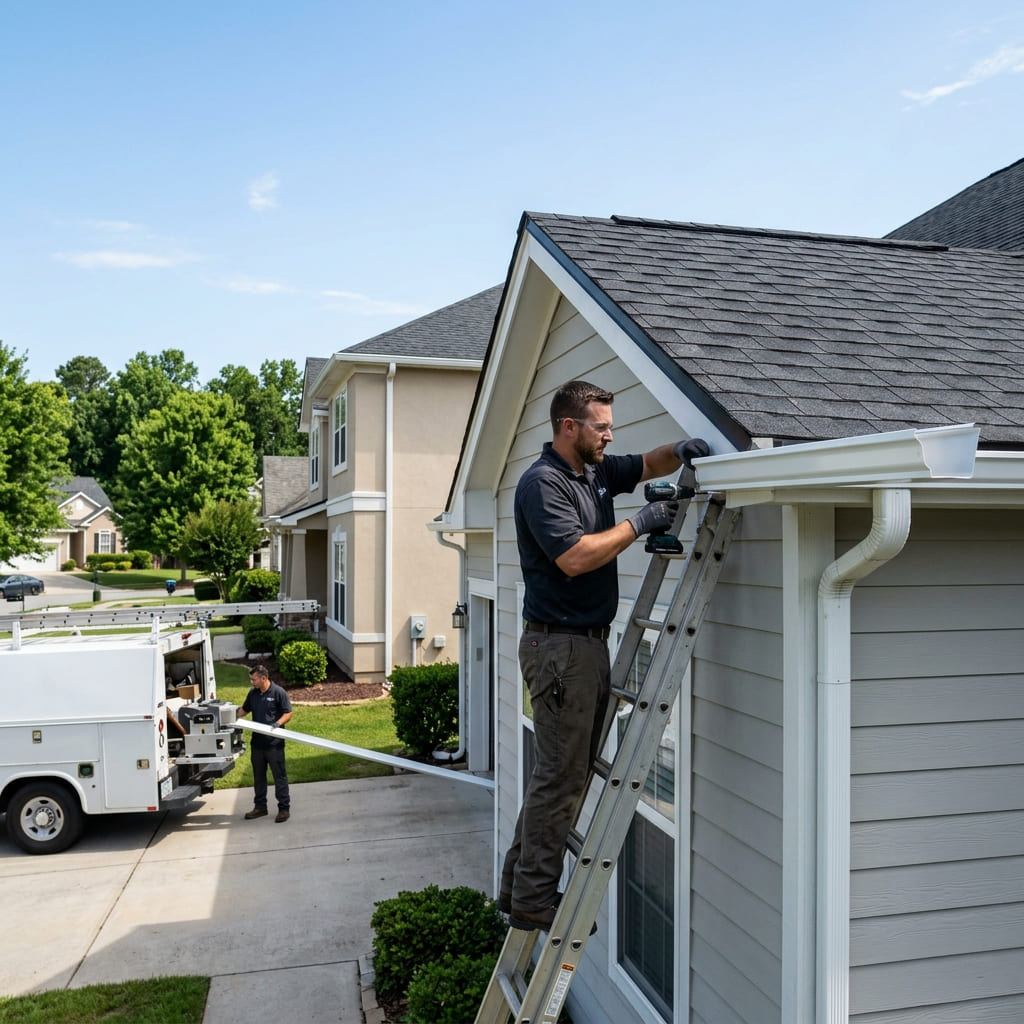
Seamless gutters are the better choice for nearly every house in Boise, and sectional gutters are the better choice for sheds, short detached runs, and DIY budgets. The reason is not the metal — both are usually the same .027 or .032 aluminum. The reason is joint count. A 180-foot sectional system carries roughly 18 sealed slip joints, and the same house in seamless carries four to eight.
Every one of those joints is a bead of sealant that has to survive the Treasure Valley
temperature swing, which routinely runs 30 degrees between a February afternoon and the
following morning.
Sealant bonds fail from that cycling long before aluminum does. That is the whole argument, and
it is why seamless has replaced sectional on nearly every home built in Ada and Canyon County
over the last three decades.
Seamless vs sectional gutters at a glance
The table below is the short version. Everything after it explains why each row lands where it does on a Boise roofline specifically.
| Seamless gutters | Sectional gutters | |
|---|---|---|
| How it is made | Roll-formed on site from coil stock | Pre-made 10-foot lengths off a shelf |
| Joints per 180-foot home | 4–8, at corners and end caps only | 18+, one every 10 feet |
| Installed cost per foot | $8–$16 aluminum | $4–$9 aluminum or vinyl |
| Runs on a 180-foot home | $1,440–$2,880 | $720–$1,620 |
| First failure point | Corner miters, usually after 10+ years | Slip joints, often within 3–7 years |
| Debris behavior | Smooth interior, water and grit move freely | Joint lips catch needles and start clogs |
| Materials available | Aluminum, steel, copper, zinc | Aluminum, vinyl, galvanized |
| Installation | Needs a truck-mounted forming machine | DIY-capable with a ladder and rivets |
| Mid-run repair | Patch, or re-form the whole run | Swap a single 10-foot section |
| Best for | Houses, garages, any run over 20 feet | Sheds, outbuildings, short runs |
How each type is actually installed
Understanding the install explains most of the cost gap, and it explains why one system has a row of weak points and the other does not.
Seamless
A roll former mounted in a trailer or truck bed sits at your curb. Flat aluminum coil in your
chosen color feeds in one end and passes through a series of shaped rollers that progressively
bend it into a K-style or
half-round profile.
The finished gutter is cut to the measured eave length and carried up as one piece. Corners are
fabricated and riveted, end caps crimped and sealed, and outlets punched where the downspouts
land — roughly ten minutes of forming per run once the measurements are set.
The practical catch is staging. A forming machine needs somewhere it can feed out 40 feet of straight gutter without kinking it. On the narrow streets of the Boise North End, on some Garden City live-work lots, and in tight cul-de-sacs in newer Meridian subdivisions, that staging decision is part of planning the job rather than an afterthought.
Sectional
Sectional gutter comes home in 10-foot lengths. Each length overlaps the next inside a slip connector, the overlap is riveted and sealed, and the assembled run is hung on the fascia. No machine, no staging, no minimum job size — which is exactly why it still exists.
The trade is that the installer creates a sealed joint every 10 feet, and the quality of the whole system becomes the quality of its worst joint. Sealant applied to a dusty or damp surface in October will not bond properly, and you will not find out until spring.
A note on gauge. Whichever system you choose, ask what thickness of aluminum is being hung. Contractors in our network quote .032 rather than .027 on homes where ladders rest on the gutters twice a year for cleaning, because .027 dents into a permanent low spot, and a low spot holds standing water.
What each one costs in the Boise market
Seamless aluminum installs for $8 to $16 per linear foot in the Treasure Valley. Sectional aluminum or vinyl runs $4 to $9. On a typical 180-foot single-family home that is $1,440 to $2,880 against $720 to $1,620 for the gutter runs alone, before downspouts.
A complete gutter system in Idaho averages $2,705 to $3,660 once downspouts,
corners, hangers, tear-off, and disposal are included, with labor sitting at roughly $61 per
hour underneath the package price.
So the seamless premium on a whole-home job usually lands between 20% and 35% — real money, but
a smaller share of the total than the per-foot numbers suggest on their own. Full breakdowns
live on the gutter installation cost page and the
gutter cost overview.
The number that usually settles it is maintenance. Resealing sectional joints is a recurring repair cost in the $150 to $650 band every few years. Two resealing visits over a decade close most of the original gap.
Why Boise weather pushes this decision toward seamless
Boise is a high-desert climate at roughly 2,700 feet, and its gutter failures do not come from rainfall volume — annual precipitation is only around 11 to 12 inches. They come from cycling and from debris.
- Freeze-thaw cycling. The Treasure Valley crosses the freezing line dozens of times between November and March. Every cycle expands and contracts metal against the sealant in a slip joint. That is fatigue loading, and sectional systems have 18 places to feel it.
- Ice load in the trough. A clogged gutter that freezes solid carries serious weight. A continuous seamless run spreads that load across every hanger; a sectional run concentrates it at the joints, which is where these systems pull apart.
- Cottonwood fluff in June. Homes near the Boise River greenbelt — Garden City, Eagle, the East End — take a heavy fluff load every June. Fluff packs against the internal lip of a slip joint and starts the clog there.
- Pine needles in the foothills. Warm Springs Mesa, the Highlands, Hidden Springs, and Collister roofs shed needles year-round. Needles are the worst debris type for jointed gutter because they mat and wedge rather than float.
- Farm and construction dust. In Nampa, Caldwell, Kuna, and around the active build sites in Star and Middleton, fine silt settles into troughs all summer, then turns to paste in the first fall rain.
- Summer UV at elevation. Vinyl sectional is the cheapest option on the shelf and the fastest to fail here. Boise UV plus winter cold makes it brittle, and brittle vinyl cracks at the joint rather than flexing.
When sectional gutters are genuinely the right answer
Sectional is not a bad product. It is a product with a narrower correct use, and pretending otherwise would be dishonest. Choose sectional when:
- The structure is a shed, shop, coop, or detached garage where mobilizing a forming machine makes no economic sense for 30 feet of gutter.
- You are doing the work yourself and the alternative is no gutter at all. A correctly pitched sectional run beats bare fascia every time.
- You need one section replaced now on an existing sectional system, and a full replacement is not in this year's budget.
- Access genuinely prevents forming on site — a landlocked rear elevation, or a steep foothills lot with no vehicle approach.
How to decide for your house
Three questions get most Boise homeowners to an answer without a site visit.
How long are your runs? Anything over about 20 feet starts accumulating joints quickly, and that is where seamless pulls ahead. Long uninterrupted eaves — the norm on new construction in Star, Kuna, and south Meridian — are the strongest case for seamless there is.
How long will you own the house? Under five years, the up-front saving on sectional may simply be the better financial call. Ten years or more and the resealing cycle erases it.
What falls on your roof? If the answer is cottonwood fluff, ponderosa needles, or maple seed, joints will find and hold that debris. That is also the point where gutter guards stop being optional — see gutter guards vs cleaning.
If you want this comparison run against your actual roofline rather than in the abstract, Boise Gutter Service can get you measured eave lengths and a written number for both approaches at no charge.
Straight answers
Seamless vs sectional gutter questions
What is the difference between seamless and sectional gutters?
Sectional gutters arrive as pre-made 10-foot lengths that are joined end to end with slip connectors and sealant. Seamless gutters are formed on site from a coil of flat metal, so a 45-foot eave receives one continuous 45-foot gutter with no joints in the middle of the run. Both carry the same water. They differ almost entirely in how many sealed connections sit between your roof and the ground.
Are seamless gutters worth the extra cost?
On a house, yes. Seamless aluminum runs $8 to $16 per linear foot installed against roughly $4 to $9 for sectional, so a 180-foot home pays somewhere between $700 and $1,300 more up front. What that buys is the removal of about 18 slip joints, which are the parts that leak first in a Boise winter. On a shed or a short detached run, sectional is the sensible call.
Can I install sectional gutters myself?
Yes. Sectional gutter is sold in 10-foot lengths at any Boise home center and is designed to be carried up a ladder by one person. The two things that go wrong on DIY installs are pitch and hanger spacing. A run needs roughly a quarter inch of fall per 10 feet toward the outlet, and hangers every 24 inches rather than the 36 or 48 inches people default to. Get either wrong and the run ponds or sags within a season.
Do seamless gutters ever leak?
They can, but in specific places. Every seamless system still has sealed points at inside and outside corners, at end caps, at downspout outlets, and at splices on runs longer than about 50 feet. Those are the spots to inspect after a hard Treasure Valley winter. What seamless removes is the row of mid-run joints that account for most sectional leaks. See gutter repair.
How long do seamless and sectional gutters last in Idaho?
Seamless aluminum typically lasts 20 to 30 years in the Treasure Valley. Sectional aluminum reaches a similar age as metal, but the joints usually need resealing every three to seven years, and vinyl sectional gets brittle much faster because Boise sits at about 2,700 feet with strong summer UV and sub-freezing winter nights. The metal rarely fails first — the seams and fasteners do.
Can sectional gutters be replaced with seamless?
Yes, and it is one of the most common jobs on older Boise homes. The old sectional comes off, the fascia is inspected and repaired where spikes have chewed it up, and new seamless runs are formed at the curb and hung on hidden hangers. Because fascia condition drives part of the price, it is worth having it looked at before assuming a straight swap. See gutter replacement.
Get a seamless gutter quote in Boise
Measured eave lengths, material and color options, and downspout placement — in writing, at no charge, before anything gets scheduled.