
Comparison guide
Gutter Guards vs Regular Gutter Cleaning
One is a large one-time cost that reduces maintenance. The other is a small recurring cost that eliminates it twice a year. Which is cheaper on your house depends almost entirely on what grows over your roof.
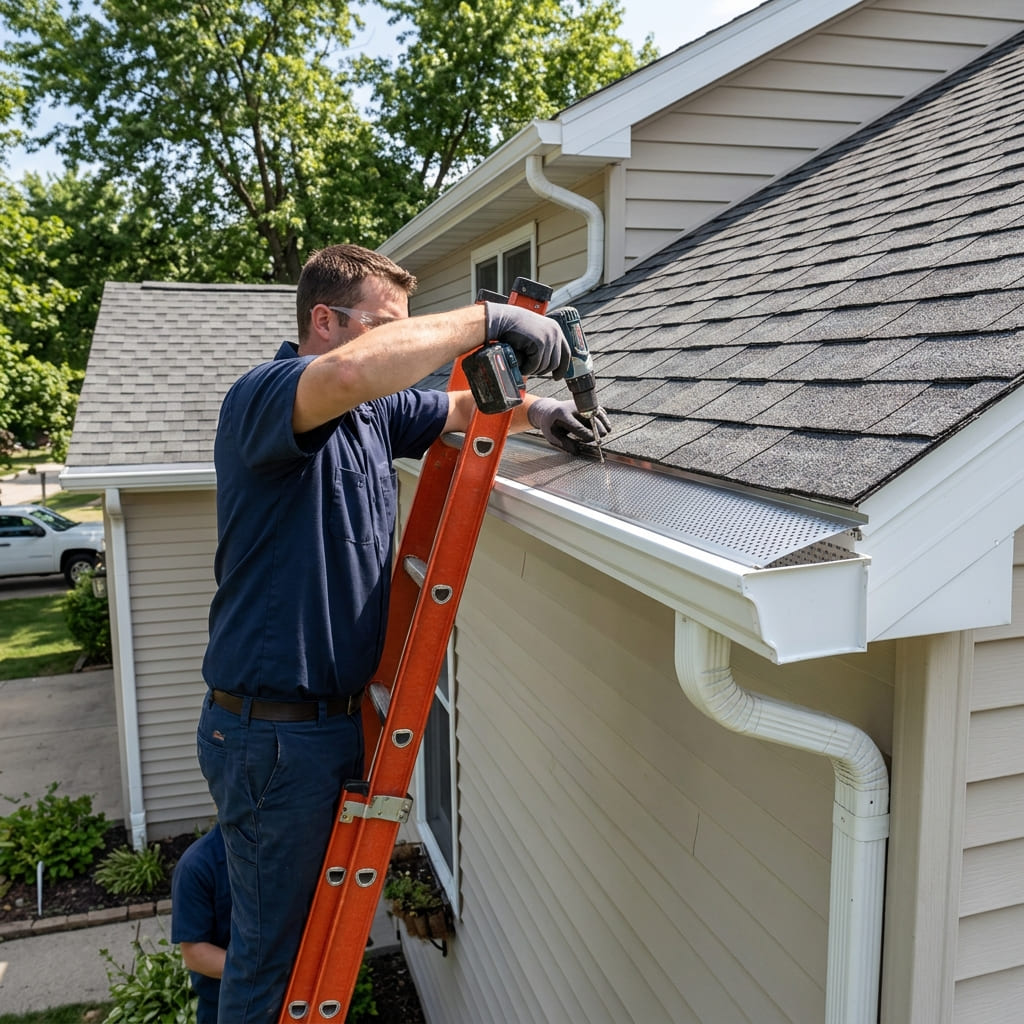
Gutter guards cost $6 to $25 per linear foot in Boise. Professional gutter cleaning costs $125 to $350 per visit, twice a year for most Treasure Valley homes. On a 180-foot house that is roughly $1,080 to $4,500 once, against $250 to $700 every year — so break-even falls somewhere between two and seven years, and the deciding factor is how many trees are actually feeding your gutters.
The honest framing is that this is not really an either-or. Guards reduce cleaning; they do not
end it.
What they genuinely eliminate is the packed-trough scooping that requires ladder time on a
two-story roofline, and for a lot of Boise homeowners that safety consideration matters more
than the arithmetic does.
Gutter guards vs cleaning at a glance
| Gutter guards | Scheduled cleaning | |
|---|---|---|
| Cost structure | One-time $6–$25 per foot | Recurring $125–$350 per visit |
| 180-foot Boise home | $1,080–$4,500 installed | $250–$700 per year at two visits |
| Ongoing maintenance | Surface brushing, outlet checks | Full interior clear-out each visit |
| Handles pine needles | Only micro-mesh does it well | Yes, completely, every visit |
| Handles cottonwood fluff | Micro-mesh yes; screens poorly | Yes |
| Ladder work for you | Greatly reduced | None, if you hire it out |
| Inspection benefit | Hides the trough from view | Someone sees the system twice a year |
| Winter behavior | Can complicate clearing a frozen gutter | A late-fall visit is the best ice defense |
| Best for | Treed lots, two-story homes, foothills | Open lots, new subdivisions, tight budgets |
The break-even math, done properly
Take a 180-foot Treasure Valley home cleaned twice a year at $175 a visit — $350 annually.
Screen or basic mesh at $6 per foot is about $1,080 installed. Against $350 a year that is roughly a three-year payback, but cheap screens do poorly against needles and fluff, so you are likely still cleaning once a year. Realistically that stretches the payback toward five or six years.
Quality micro-mesh at $18 per foot is about $3,240 installed. If it drops you to
a single light maintenance visit a year, you are saving perhaps $175 annually against $3,240 —
an 18-year payback on cost alone.
Nobody buys micro-mesh on that math. They buy it because a foothills home under ponderosas needs
three cleanings a year rather than two, because the roofline is high and steep, or because they
simply do not want the ladder in the equation any more.
That is the honest conclusion: guards win clearly on heavy-debris properties and on hard-access rooflines. On an ordinary lot they are a convenience purchase, not a savings one. Full pricing sits on the gutter cleaning cost and gutter cost pages.
One thing cleaning gives you that guards take away. A cleaning visit puts eyes on the whole system twice a year — loose hangers, separated seams, a run that has lost pitch, fascia starting to soften. Guards hide the trough. If you install them, it is worth scheduling an inspection every couple of years so problems still get caught before they turn into repairs.
What Boise actually drops into gutters
Guard selection is a debris question, and Treasure Valley debris is specific enough that generic advice gets it wrong.
- Ponderosa and pine needles — foothills neighborhoods like Warm Springs Mesa, the Highlands, Collister, and Hidden Springs. Needles fall year-round, mat into a fibrous plug, and defeat every guard type except micro-mesh.
- Cottonwood fluff — a June event along the Boise River corridor through Garden City, the East End, and Eagle. Fluff mats with the first rain into something closer to felt than to leaves.
- Maple and locust seed — the North End, Boise Bench, and older Nampa and Caldwell streets. Small, heavy, and perfectly sized to lodge in a downspout outlet.
- Farm and construction silt — Kuna, Middleton, Star, and the agricultural edges of Canyon County. Fine dust settles all summer and turns to paste in the first fall rain, which is what blinds micro-mesh over time.
- Shingle grit — every home with an aging asphalt roof, which in the older subdivisions of Meridian is most of them. Grit is abrasive and settles in the bottom of the trough regardless of what is on top.
Note how much of that list is fine material rather than leaves. Guards marketed on leaf photos are being sold against the wrong problem for this valley.
Guard types, ranked for Treasure Valley conditions
Not all guards are the same product, and the price range reflects genuinely different performance.
- Micro-mesh ($15–$25/ft) — stainless mesh over a rigid frame. The only type that reliably stops needles, fluff, and seed. Needs occasional surface brushing where silt and pollen create a film. The right answer for foothills and greenbelt homes.
- Standard mesh or screen ($6–$12/ft) — keeps out leaves and twigs, passes needles and fluff. Reasonable on an open lot with a couple of deciduous trees; poor value anywhere with conifers.
- Reverse-curve ($15–$25/ft) — uses surface tension to carry water around a curved nose while debris falls past. Works on large leaves; needles and fluff ride the water straight in. Also the most visible type from the ground.
- Foam and brush inserts ($3–$6/ft) — cheap and easy, and they trap the fine debris that dominates Boise gutters, which means you are eventually pulling out saturated foam instead of scooping a trough. Rarely worth it here.
How to decide for your house
Count the trees within reach of your roof. Zero to two deciduous trees means scheduled cleaning is almost certainly cheaper. Mature conifers overhanging the roof means micro-mesh is worth pricing seriously.
Look at the access. A single-story ranch in Meridian is a straightforward cleaning job. A three-story foothills elevation over a slope is a different proposition, and the case for guards there is partly about not putting anyone on that ladder four times a decade.
Check the gutters themselves first. Guards on a sagging, back-pitched, or leaking system lock in the problem and make it harder to reach. If the runs need work, sort that out before adding anything on top — see gutter repair vs replacement.
Boise Gutter Service can give you both numbers for your address — a per-foot guard price for your measured runs and a per-visit cleaning price — so you can compare them against your own trees instead of a generic break-even chart.
Straight answers
Gutter guard and cleaning questions
Do gutter guards eliminate the need for cleaning?
No, and anyone who says otherwise is overselling. Good guards convert twice-yearly interior cleaning into occasional surface maintenance — brushing shingle grit and pollen paste off micro-mesh, clearing needles that bridge across the top, and checking that outlets still flow. What they eliminate is the ladder work of scooping a packed trough. They do not make a gutter maintenance-free.
Are gutter guards worth it in Boise?
It depends almost entirely on your trees. On a foothills lot under ponderosa pines, or a greenbelt home taking cottonwood fluff every June, guards usually pay for themselves in three to five years and remove a genuine safety problem. On a young subdivision lot in Kuna or Star with no mature trees, guards solve very little — an annual cleaning is cheaper and sufficient.
How much do gutter guards cost compared to cleaning?
Guards install for $6 to $25 per linear foot depending on type, so a 180-foot Boise home lands between roughly $1,080 and $4,500. Professional cleaning runs $125 to $350 per visit, or about $250 to $700 a year at two visits. That puts break-even somewhere between two and seven years depending on which guard you buy and how often you would otherwise clean.
Which gutter guards work best for pine needles?
Micro-mesh, and it is not close. Needles slip straight through screens and standard mesh, and reverse-curve guards let them ride the water into the trough. Micro-mesh has openings small enough that needles sit on the surface and blow off. It is also the most expensive type, which is the trade-off for the foothills homes that need it most. See gutter guards.
Can gutter guards cause ice dams?
Guards do not cause ice dams — inadequate attic insulation and ventilation do, by letting heat melt snow that refreezes at the cold eave. What guards can do is give ice a surface to form on and make a frozen gutter harder to clear once it happens. In Boise’s freeze-thaw winters that is a real consideration, and it is another reason guards are a maintenance-reduction tool rather than a cure-all.
How often should Boise gutters be cleaned without guards?
Twice a year for most Treasure Valley homes — once in late spring after cottonwood fluff and seed drop, and once in late fall after the leaves are down but before the first hard freeze. Homes under mature pines often need three visits, and homes on open new-construction lots can usually manage on one. See gutter cleaning.
Guards or cleaning? Get both quoted.
Tell us what is growing over your roof and get written pricing for gutter guards and for a cleaning schedule — no charge either way.