
Ada County · Pop. 25,000
Gutter Services in Star, ID
Up 131% since 2020 and still building — almost entirely new homes on former farm ground, with brand-new gutters that are frequently undersized from day one.
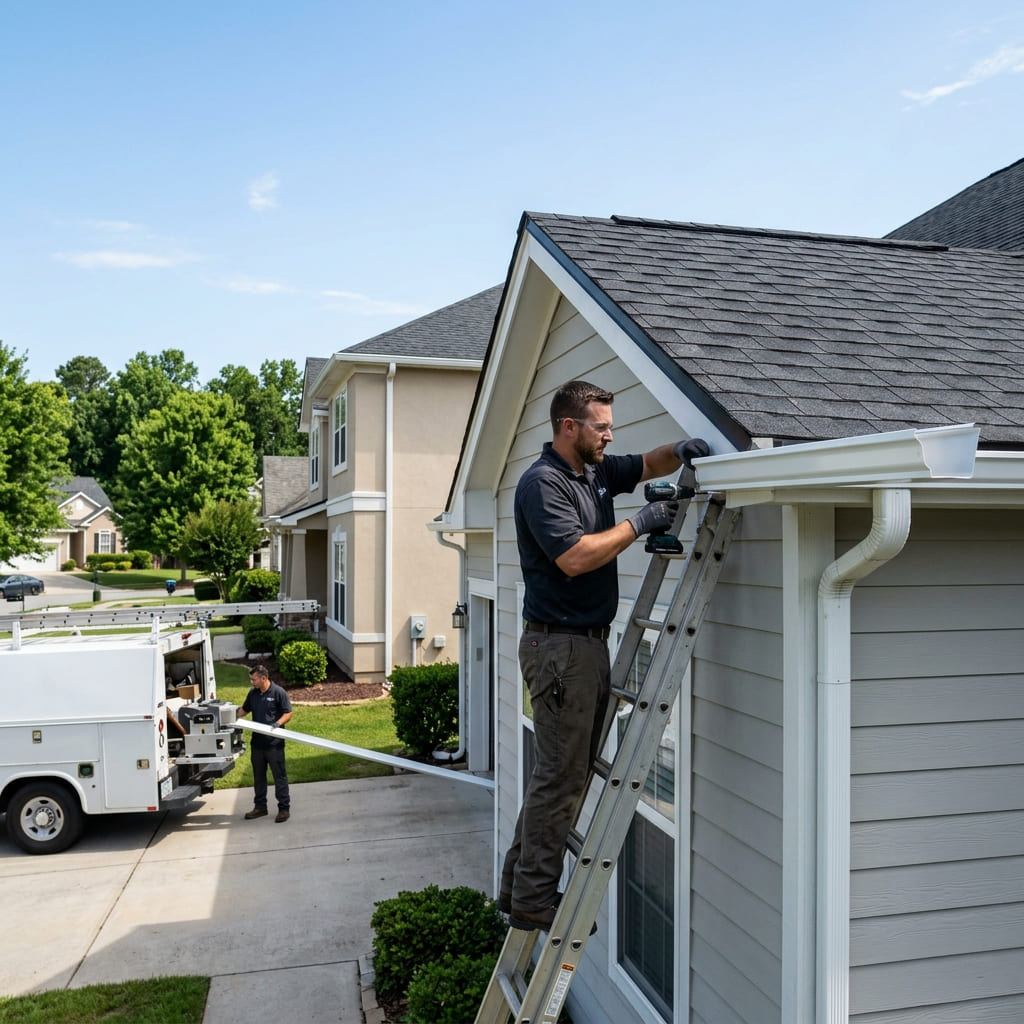
Gutter cleaning in Star, ID runs $150 to $300, and most homes here carry 160 to 200 linear feet of gutter that is less than ten years old. Star has grown roughly 131% since 2020 — the fastest rate in the Treasure Valley — and that produces a gutter market unlike anywhere else in the metro. Almost nothing here needs replacing. Plenty of it needs correcting.
New gutters, old problems
The gutters on a Star home are typically in excellent condition. The aluminum is young, the fascia is sound, the sealant at the corners has not been through enough winters to fail. What is wrong, when something is wrong, is the design rather than the condition.
Production builders across Star install a standard package: 5-inch K-style aluminum, 2x3 downspouts, and the minimum number of outlets. That package is adequate on a simple single-story roof. It is frequently not adequate on the two-story elevations with steep pitches and multiple valleys that dominate new construction here. The result is a house that overflows at one consistent corner every spring while the rest of the system works fine.
The correction is targeted, not wholesale. Adding an outlet to the overloaded run, upsizing that one section to 6-inch, or converting a 2x3 downspout to 3x4 addresses the actual problem for a few hundred dollars. Replacing the whole system would be spending thousands to fix two runs. See gutter repair.
The windbreak effect
Star is being built on ground that was farmed for a century, and the farms left something behind that surprises new homeowners: windbreak rows. Long lines of Lombardy poplar, cottonwood, and Russian olive were planted decades ago to shelter fields from the wind that comes down the Boise River corridor, and many of those rows are still standing at the edges of new subdivisions.
Those mature trees drop far more material than anything in the new landscaping, and they drop it unevenly. A house backing onto a poplar row can need three cleanings a year while an identical house two streets over genuinely needs one. Cottonwood is the worst of them — the June seed fluff mats into a felt layer in the trough that water simply cannot pass through, and it drops heavy deadwood without warning.
If your Star home backs onto one of these rows, micro-mesh guards are worth pricing. If it does not, they are probably premature.
Flat ground, fresh grading, and where water goes
Star sits on flat river-valley ground north of the Boise River, and its newest subdivisions were laser-leveled for irrigation before they were ever platted. That combination — flat topography, compacted construction subsoil, and immature landscaping with no established root structure — means roof water has nowhere to go on its own.
On lots close to the river the water table is also higher than most of the valley, which compounds it. A downspout discharging onto a splash block a foot and a half from the wall is putting concentrated roof water into soil that is already near capacity. Extensions carrying discharge six to ten feet out, or a buried solid PVC line to a pop-up emitter at the lot's low corner, is the difference between a dry crawlspace and a recurring problem. Full detail on downspouts and drainage.
Worth checking on a new build: confirm that the grade still slopes away from the house. Backfill around a new foundation settles over the first two or three years, and a lot that drained correctly at closing can develop a reverse slope by the time the landscaping matures.
What Star homes usually need
- Selective 6-inch upgrades on the one or two runs that serve a valley or a steep two-story elevation.
- Additional downspout outlets where the builder installed the minimum count on a long run.
- 2x3 to 3x4 downspout conversions on homes near conifer or windbreak plantings.
- Discharge extensions or buried lines to move water off flat, compacted lots.
- Annual or twice-yearly cleaning, weighted by proximity to old windbreak rows.
- New installation on outbuildings — shops and detached garages on the larger lots along Star Road and Can-Ada Road are often built without gutters.
Areas we cover in Star
Service covers downtown Star, the State Street and Highway 44 corridor, the Star Road and Can-Ada Road subdivisions, Beacon Light Road, and the properties along the Boise River corridor. Adjacent coverage includes Eagle to the east, Middleton to the west, and Meridian to the south.
Gutter services available in Star
Every service we offer is available in Star and the surrounding Ada County area. Follow any of these for process detail, materials, and pricing.
Nearby cities we also cover
Star sits inside a service area that covers the whole Treasure Valley. We work in Eagle , Middleton and Meridian on the same schedule, alongside our core gutter installation and cleaning in Boise. The full list is on the service areas page.
Straight answers
Gutter questions from Star homeowners
My Star home is only four years old. Why do the gutters already overflow?
Almost always because the builder package was minimal rather than defective. Production builders install 5-inch gutter with 2x3 downspouts and the fewest outlets that will pass inspection. On a two-story elevation with a roof valley feeding one section, that section receives more water than 5-inch gutter can carry no matter how new or clean it is. Adding an outlet or upsizing that one run usually solves it for a few hundred dollars.
Why do my new-build gutters fill with leaves when there are no trees?
Because the trees are older than the subdivision. Star was farmland until recently, and a lot of neighborhoods still back onto surviving windbreak rows — Lombardy poplar, cottonwood, and Russian olive planted decades ago to shelter fields. Those rows drop heavily onto whichever new roof happens to sit downwind, which is why some Star homes need two cleanings and the house across the street needs none.
How much does gutter cleaning cost in Star?
Star gutter cleaning typically runs $150 to $300. Most homes here are two-story with 160 to 200 linear feet of gutter, which puts them squarely in the middle of the Treasure Valley range. Homes backing onto old windbreak rows or the Boise River corridor sit at the higher end because of the debris load.
Should I add gutter guards to a brand-new Star home?
Usually not yet. Guards make financial sense when debris load is heavy enough that you are cleaning three times a year, and most Star lots with young landscaping are not there. The exception is homes backing onto a mature windbreak row or the river corridor — those genuinely do collect enough to justify micro-mesh. For everyone else, one or two cleanings a year is the cheaper answer.
Get a free gutter estimate in Star
Call 208-506-2338 and describe your roofline. Free written estimates across Star and the rest of the Treasure Valley — cleaning, repair, guards, and full seamless replacement.