
Comparison guide
Gutter Repair vs Replacement: How to Decide
A $300 repair on a system that needs $2,000 of work is money thrown away. A full replacement on a system with one bad corner is the same mistake in the other direction. Here is where the line actually sits.
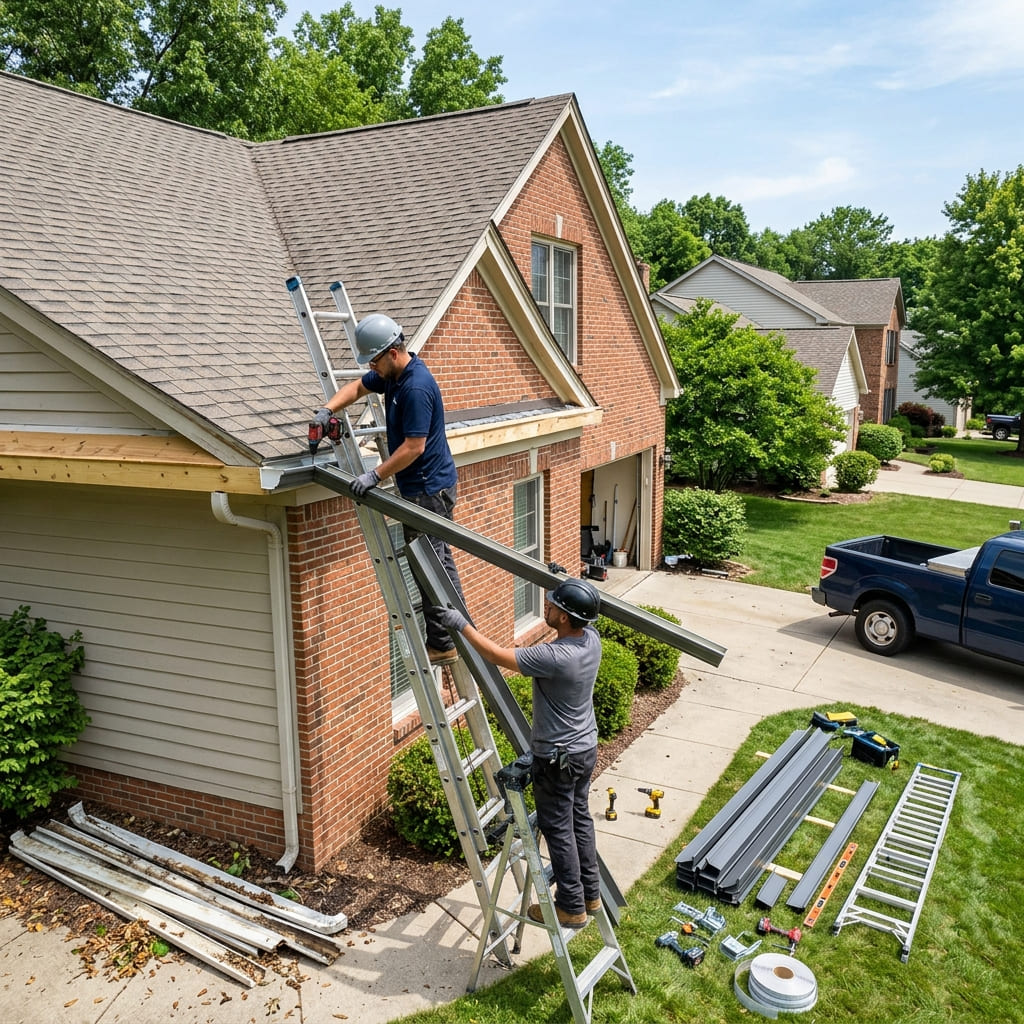
Repair when the problem is local and the rest of the system is sound. Replace when outstanding repairs would exceed roughly 40% of replacement cost, or when the same failure keeps appearing in new places. In the Boise market that means comparing a $150 to $650 repair against a $2,705 to $3,660 replacement — and the number of failure points matters more than the severity of any one of them.
The mistake most homeowners make is treating each leak as an isolated event. Three separate
$250 repairs across two years on a 22-year-old aluminum system is $750 spent to postpone a
decision that was already made.
The opposite mistake is just as common — replacing a perfectly good ten-year-old system because
one corner miter opened up over a hard winter.
Repair vs replacement at a glance
| Symptom | Usually repair | Usually replace |
|---|---|---|
| Leaking | One or two seams or corners | Leaks appearing at new joints each season |
| Sagging | A single section, hangers still bite | Multiple runs, hangers pulling out of fascia |
| Holes or rust | A few pinholes, patchable | Rust through in several places on a steel system |
| Pitch | One run needs repitching | System-wide ponding after settlement |
| Fascia | One soft board behind a run | Soft or split fascia along several elevations |
| Storm damage | One crushed section from a limb | Sliding snow has torn runs off the house |
| Age | Under 15 years, aluminum | 20+ years aluminum, or any failing vinyl |
| Capacity | Add a downspout | Whole system is undersized for the roof |
| Typical cost | $150–$650 | $2,705–$3,660 average in Idaho |
The 40% rule, and how to apply it
Get a full list of what the system needs — not just the leak that prompted the call. Total it, and compare that total to what replacement would cost on the same house.
Under 40%: repair. You are buying years of service for a fraction of the cost,
and the remaining system has life in it.
Over 40%: replace. At that point you are paying a substantial share of a new
system to extend one that is failing in several places at once, and the next failure is already
queued up somewhere you have not looked.
Weight the answer by age. On a 25-year-old aluminum system, a 30% repair bill is still usually the wrong purchase, because the remaining runs are on the same clock as the ones that failed. On a 10-year-old system, even 50% can be worth spending if the damage came from a single event like a fallen limb.
What individual repairs cost in Boise
Repairs in the Treasure Valley generally run $150 to $650, with Idaho gutter labor sitting around $61 per hour underneath the quoted price. Access drives cost more than the repair itself does — a third-story fix that takes an hour of ladder setup for fifteen minutes of work is priced on the setup.
- Resealing a corner or end cap — the most common call after a Boise winter, and the cheapest.
- Rehanging a sagging run — new hidden hangers at 24-inch spacing, often replacing old spikes.
- Repitching a run — resetting fall toward the outlet so water stops ponding.
- Patching holes — pinholes and small punctures in an otherwise sound trough.
- Downspout work — reattaching, replacing a crushed section, clearing a blockage, adding extensions.
- Fascia repair — replacing a soft board behind a run before anything is rehung on it.
Detailed pricing by repair type is on the gutter repair cost page, and the full service is covered on gutter repair.
Fascia is the line item that changes the answer. If the wood behind your gutters has gone soft, there is nothing solid to fasten to, and no repair holds. Fascia damage along multiple elevations moves a borderline case firmly into replacement territory, because the boards have to come off anyway and the gutters come off with them.
Boise conditions that shorten the repair window
A gutter system in the Treasure Valley ages differently than one in a wetter, milder climate, and the local stressors are worth understanding when you are weighing a repair.
- Freeze-thaw cycling. Dozens of crossings of the freezing line between November and March work every sealed joint on the house. This is why resealing is a recurring rather than a permanent fix, and why a system that needs it in three places will soon need it in five.
- Ice load. A clogged trough that freezes solid is heavy, and that weight lands on the hangers. Repeated ice loading is the single most common reason Boise gutters pull away from fascia. See gutter cleaning.
- Sliding snow from metal roofs. Increasingly common on foothills and Eagle builds. Snow releases in one sheet and can tear a run off its hangers outright — that is storm damage, not wear, and it is often a partial replacement.
- Summer UV at 2,700 feet. Hard on sealants and brutal on vinyl. If your home still has vinyl gutter, repair is rarely worth pursuing once it starts cracking.
- Soil movement. On hardpan and clay ground around Kuna and parts of Canyon County, settlement changes roofline geometry slightly over decades, which shows up as runs that have quietly lost their pitch.
What replacement gets you that repair cannot
Replacement is not just newer versions of what you have. It is the only moment where the underlying specification can change, and on many older Boise homes that specification was wrong from the start.
Sizing. If the roof has always overflowed in hard rain, replacement is when you move to 6-inch troughs and 3x4 downspouts or add outlets.
Joint count. Going from sectional to seamless removes roughly 18 leak points from a 180-foot house in one step.
Hanger system. Old spike-and-ferrule at 36-inch spacing becomes hidden hangers at 24 inches, which is most of why new systems survive ice better than the ones they replace.
Material. Replacement is the natural time to weigh steel over aluminum on a metal-roofed or heavily treed property, or copper on architecture that warrants it.
Getting an answer you can trust
Ask for the full defect list in writing rather than a price for the one leak you noticed, and ask for a replacement number on the same visit. Two numbers on one page is what makes the 40% test usable.
Then ask three follow-ups: how old the system is, whether the fascia is sound, and whether the failures are clustered in one area or spread across the house. Clustered damage from a single cause is a repair. Spread-out damage from age is a replacement.
Boise Gutter Service can walk the system, list what it actually needs, and price repair and replacement side by side at no charge, so the comparison is made on your roofline rather than on a rule of thumb. More detail is on the gutter replacement and gutter cost pages.
Straight answers
Gutter repair vs replacement questions
Is it cheaper to repair or replace gutters?
Repair is far cheaper in the moment — $150 to $650 against a $2,705 to $3,660 Idaho average for a full replacement. The useful test is the ratio, not the absolute number: if the outstanding repairs on your system would total more than roughly 40% of replacement cost, replacing is the better spend. Below that line, repair and defer.
How do I know if my gutters need replacing?
Look for problems that repeat across the whole system rather than at one point. Multiple separated seams, sagging on more than one run, numerous rust holes or cracks, spike holes that no longer hold, and fascia that has gone soft behind the gutter all point to replacement. A single leaking corner or one sagging section is a repair, even on an old system.
How long should gutters last in Boise?
Seamless aluminum typically gives 20 to 30 years in the Treasure Valley, coated steel a similar span depending on the coating, and copper 60-plus. Vinyl rarely reaches 15 here because Boise combines strong summer UV at 2,700 feet with sub-freezing winter nights, and that cycle makes vinyl brittle. Past about 20 years on aluminum, repairs start becoming a losing proposition.
Can one section of gutter be replaced instead of the whole system?
On a sectional system, yes — that is the point of 10-foot sections. On a seamless run there is no mid-run joint to open, so a damaged center section usually means re-forming that entire run rather than swapping a piece. That is why seamless is quoted per run. Color matching on a 15-year-old system is the other practical limit; new coil rarely matches sun-faded gutter exactly.
Does gutter replacement include fascia repair?
Not automatically, and it is the line item most often missing from a low quote. On older Boise homes where spike-and-ferrule gutters have been pulling on the same holes for decades, the fascia behind the gutter is frequently soft or split. It has to be sound before new gutters hang on it. Always ask whether fascia inspection and repair are included or billed separately.
Should I replace gutters before winter in Idaho?
If they are already failing, yes. A gutter that ponds water is a gutter that will hold ice, and ice load is what tears runs off fascia during a Treasure Valley freeze-thaw winter. Late summer through mid-fall is the practical window — installers are available, temperatures are still right for sealants to cure properly, and the work is finished before the first hard freeze.
Repair or replace? Get both priced.
A written defect list with repair and replacement numbers side by side, at no charge and with no obligation.