
Gutter materials
Copper Gutters in Boise, ID
A 60-plus year system with soldered joints and a patina that moves from bright penny to deep brown — the gutter you install once and never think about again.
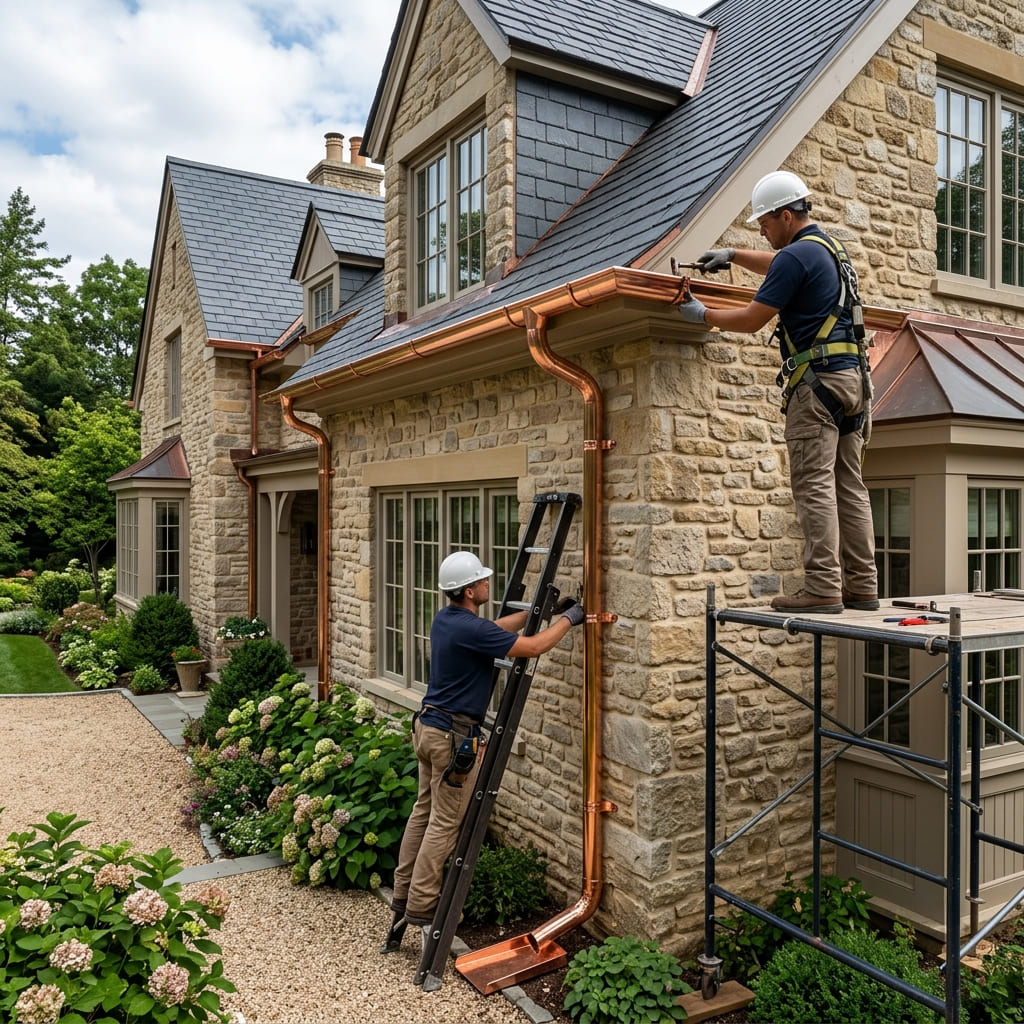
Copper gutters in Boise, ID install for $25 to $45 per linear foot and last 60 years or more. On a 180-foot home that is roughly $4,500 to $8,100 for the gutter runs, plus $30 to $50 per foot for matching copper downspouts. It is the most expensive gutter material in common use and the only one that will realistically outlive the roof above it.
Copper shows up in two places in the Treasure Valley: custom homes in Eagle and the foothills where the architecture calls for it, and period restorations in Boise's North End and East End where it is the historically correct material. Both are legitimate reasons. What copper is not is a value upgrade over aluminum for pure water management — as a functional system, seamless aluminum moves the same water for a third of the price.
Why copper lasts as long as it does
Copper lasts because of two properties working together, and neither one applies to any other common gutter material.
The patina is protective. Copper does not rust — it oxidizes, and the oxide layer that forms is stable and adherent. Rather than flaking off and exposing fresh metal the way iron oxide does on steel, copper's patina seals the surface and slows further oxidation. The metal underneath stays sound for decades.
The joints are soldered. Every other gutter system depends on a sealant at corners, end caps, and outlets, and sealant is the part that fails first in Boise — freeze-thaw cycling breaks the bond, water finds the gap, and you are resealing miters every eight to twelve years. Copper joints are soldered, forming a permanent metallurgical bond with no consumable component. There is nothing there to age out.
How copper patinas in the Boise climate
Copper patina develops differently in the Treasure Valley than the photos on most gutter websites suggest, and it is worth setting expectations before installation.
First, new copper arrives bright — a warm pink-orange that looks almost like a new penny and is considerably more assertive than most homeowners expect. Second, within roughly six to eighteen months it darkens through russet to a deep chocolate brown. That brown is the color most Boise copper gutters will be for the majority of their lives. Third, the classic blue-green verdigris develops only with sustained moisture and airborne sulfur compounds — conditions common in coastal and industrial climates and uncommon in a dry high-desert valley. Here, verdigris typically takes 15 to 30 years and often develops unevenly, concentrated where water sits longest.
Plan for the runoff: during the first year or two, water coming off new copper carries dissolved copper compounds that stain light-colored stone, stucco, and concrete blue-green. If your elevation has light stucco or a limestone water table below the gutter line, decide in advance where the downspouts discharge.
Copper gutter profiles and downspouts
Copper is formed in both common profiles, and the choice is usually driven by architecture rather than performance.
- Half-round copper — the traditional pairing, and the profile you see on historic buildings. A smooth semicircular trough hung on exterior brackets. It sheds debris better than K-style because there are no interior corners for sludge to pack into, which is a genuine advantage under cottonwood or pine.
- K-style copper — the ogee profile, carrying more water per inch of width and mounting flush to fascia. The right choice when capacity matters or when the roofline is contemporary.
- Copper downspouts — round or rectangular, at $30 to $50 per foot, soldered at joints and strapped with copper hardware. Mixing copper gutters with aluminum downspouts is possible but looks wrong within a year as the two materials weather apart.
Where copper is used in the Treasure Valley
Copper concentrates in a few identifiable places around the Boise metro, and the reasoning is consistent in each.
Eagle custom homes — the largest share of copper work in the valley. Complex rooflines with dormers, multiple gables, and stone or heavy-timber elevations where copper reads as part of the architecture rather than as trim. Frequently paired with Corten steel accents on contemporary builds.
North End and East End restorations — Craftsman and Tudor homes from the 1900s to 1930s where half-round copper is the historically correct profile and material. On these houses copper is often the choice that a design review or preservation guideline points toward.
Partial-elevation accents — a common compromise. Copper on the front entry elevation where it is visible, seamless aluminum in a matching bronze finish everywhere else. It captures most of the visual effect at a fraction of the whole-house cost, and it is a completely reasonable way to use the material.
Maintaining copper gutters
Copper needs the same debris maintenance as any other gutter and almost nothing else. Clearing leaves and grit twice a year matters just as much — ice load in a packed copper trough will damage fasteners and fascia exactly the way it does in aluminum. See gutter cleaning.
Two copper-specific notes. Do not pressure wash copper to "clean up" the patina — it strips the protective oxide layer and restarts the whole weathering process unevenly. And avoid direct contact between copper and aluminum or galvanized steel hardware; dissimilar metals in contact with moisture set up galvanic corrosion that eats the less noble metal. Copper systems get copper or stainless fasteners throughout.
Straight answers
Copper gutter questions
How much do copper gutters cost in Boise?
Copper gutters install for $25 to $45 per linear foot in the Boise market, with half-round copper at the upper end and copper downspouts running $30 to $50 per foot. On a 180-foot home that is roughly $4,500 to $8,100 for the gutter runs alone. The premium over aluminum is about three to one, and the service life is about three to one as well.
How long do copper gutters last?
Copper gutters last 60 years or more, and well-maintained systems on historic buildings have gone considerably longer. Copper does not rust — it oxidizes into a stable protective patina that actually shields the metal underneath. The practical service life is usually limited by the fasteners and the fascia they hang on rather than by the copper itself.
How long does copper take to patina in Idaho?
Copper darkens from bright penny to a deep brown within six to eighteen months, and the brown holds for years. The classic green verdigris takes much longer in Boise than it does in coastal climates — often 15 to 30 years — because patina development depends on moisture and airborne sulfur, and the Treasure Valley is dry. Homeowners here should expect a rich brown for most of the system's life, not green.
Will copper gutters stain my siding or stonework?
They can during the first year or two. As copper weathers, runoff carries dissolved copper compounds that leave blue-green streaking on light stone, stucco, and concrete directly below. It is most noticeable at downspout discharge points. The fix is planning — direct discharge onto a splash surface that will not show it, or accept the patina as part of the look. On light stucco elevations this is worth discussing before installation.
Are copper gutters seamless?
Copper can be roll-formed seamlessly the same way aluminum is, and long runs typically are. The key difference is the joints: copper corners and outlets are soldered rather than sealed with a caulk-type product. A soldered joint is a permanent metallurgical bond, which is a large part of why copper systems outlast everything else — there is no sealant to age out through Boise's freeze-thaw cycling.
Is copper worth it on a Boise home?
Copper is worth it when the architecture supports it and you plan to keep the house. On a custom home in Eagle or a period restoration in the North End, copper is an architectural element that also happens to be the longest-lasting gutter available. On a standard subdivision two-story, it is a very expensive way to move water that seamless aluminum moves identically. Both answers are legitimate — it depends which job you are hiring it for.
Get a copper gutter quote
Full-house copper, or copper on the entry elevation with matching aluminum elsewhere. We will price both so you can compare honestly.