Comparison guide
Aluminum vs Steel Gutters
Aluminum never rusts. Steel does not dent. For a modest price difference, the choice comes down to what actually lands in your gutters — ladders, limbs, or a roof full of sliding snow.
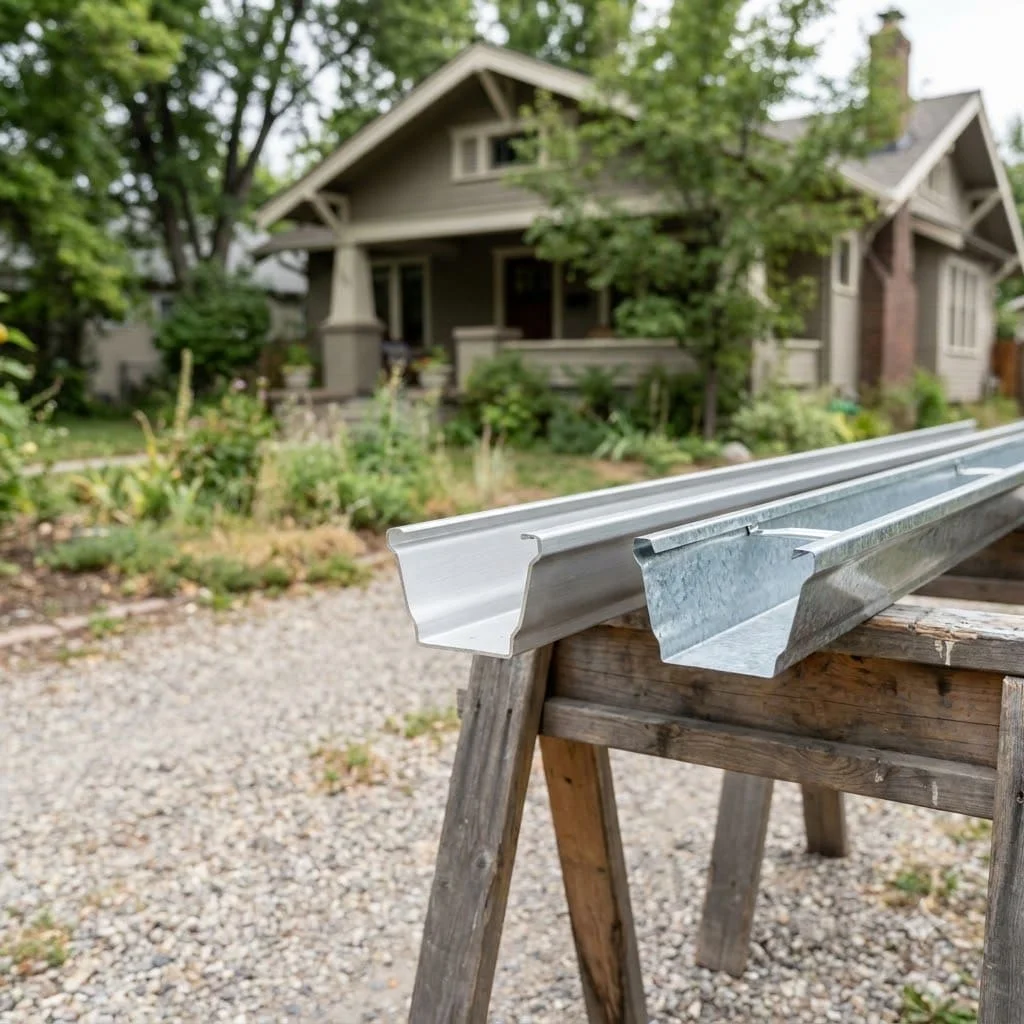
Aluminum gutters cost $8 to $16 per linear foot in Boise and never rust. Steel gutters cost $10 to $18 per foot and resist dents that would crease aluminum. Unlike the aluminum-versus-copper decision, this one is not about money — the gap is usually 15% to 25%. It is about impact.
Aluminum is the Treasure Valley default and deserves to be. It is rustproof, light enough to
hang in long unsupported runs, available in 25-plus baked-on factory colors, and it is what
nearly every subdivision home in Meridian,
Kuna, and Star already has.
Steel earns its place on a narrower set of houses: metal roofs that dump snow, lots under mature
trees, and properties where the gutters take ladder traffic several times a year.
Aluminum vs steel gutters at a glance
| Aluminum | Steel | |
|---|---|---|
| Installed cost per foot | $8–$16 | $10–$18 |
| Runs on a 180-foot home | $1,440–$2,880 | $1,800–$3,240 |
| Corrosion | Never rusts — forms a stable oxide skin | Rusts where zinc or galvalume coating is broken |
| Dent resistance | Moderate — .027 dents easily, .032 less so | High — takes ladders and limbs without creasing |
| Weight | Light — roughly a third of steel | Heavy — needs stronger fascia and closer hangers |
| Snow and ice load | Deforms under sliding snow from metal roofs | Holds shape under concentrated load |
| Finish options | 25+ baked-on colors | Fewer colors; galvalume often left mill finish |
| Seamless forming | Standard, fast to form and hang | Available, slower to form and handle |
| Repairs | Easy — patch, reseal, rehang | Harder — cut edges must be re-protected |
| Service life in the Treasure Valley | 20–30 years | 20–30 years, coating-dependent |
| Best for | Most Boise-area homes | Metal roofs, treed lots, high ladder traffic |
The two failure modes are different, and that is the whole decision
Both materials give you roughly the same 20 to 30 years in Boise. They just spend those years differently.
Aluminum fails by deformation. A ladder rested on the front lip leaves a
crease. A crease becomes a low spot. A low spot holds standing water, that water freezes on a
January night, and the ice pries the hanger loose.
Nothing about the aluminum has corroded. The trough simply stopped being the right shape, and
once pitch is gone the run pools regardless of how good the metal is.
Steel fails by corrosion at the edges. Galvanized and galvalume coatings protect the face of the metal, but every cut end, screw hole, and rivet is a place where bare steel is exposed. In Boise’s dry air that process is slow — far slower than in a coastal or Midwest climate — but it is the clock that governs a steel gutter’s life.
So the question is not which metal is stronger. It is which failure your house is more likely to cause. If nothing ever hits your gutters, aluminum will outlive steel on your roofline. If something hits them every winter, the reverse is true.
Galvanized vs galvalume steel
If you go with steel, the coating matters more than the gauge. There are two practical choices in the Boise market.
- Galvanized — steel dipped in zinc. The cheaper option and the more common one on older installations. The zinc sacrifices itself to protect exposed steel, which works well until the zinc in that area is used up.
- Galvalume — coated with an aluminum-zinc alloy. It costs a little more and holds up noticeably longer, particularly at cut edges. If you are choosing steel for durability, choosing galvanized to save a few percent undercuts the entire reason you chose steel.
A third option worth knowing about is Corten weathering steel at $20 to $35 per foot, which is designed to form a stable rust-orange patina rather than resist rust. It is an appearance choice for modern-rustic foothills and Eagle builds, not a low-maintenance one — Corten runoff stains concrete and stone below it.
Steel is heavier, and the fascia has to carry it. A full steel gutter loaded with wet debris or ice is a real load on a fascia board. On older Boise homes where the fascia has already been chewed up by decades of spike-and-ferrule gutters, that board often needs repair or replacement before steel goes up. It is a common line item on a gutter replacement quote and worth asking about before you compare prices.
Where each material fits in the Treasure Valley
- Standing seam or corrugated metal roofs — steel, and ideally 6-inch. Metal roofing releases snow in sheets, and that impact is the single most common reason a Treasure Valley gutter gets torn off its hangers.
- Foothills and Boise River corridor lots with mature trees — steel, if limbs come down in wind events. Warm Springs Mesa, Collister, Hidden Springs, and the cottonwood stretches through Garden City all qualify.
- Homes cleaned from ladders twice a year — steel, or aluminum in .032 gauge. The cheap .027 aluminum is the one that ends up creased.
- Standard asphalt-shingle subdivision homes — aluminum. Snow slides off shingles gradually, and nothing else is hitting the gutter. Steel here is spending for a problem you do not have.
- Homes where color matching matters — aluminum. The baked-on coil color range is far wider, and factory enamel handles Boise UV at 2,700 feet better than field paint.
- Agricultural-edge properties in Nampa and Caldwell — either works, but keep them clean. Farm silt holds moisture against steel and accelerates the rust clock.
What to do if you are not sure
Walk your roofline once and look for evidence rather than guessing. Existing dents, creases, or
a section that has pulled away from the fascia tell you impact is a live problem on that house,
and that is a vote for steel.
Clean, straight aluminum after 15 years tells you nothing is hitting it, and there is no reason
to upgrade.
Also check where your downspouts land and whether the runs are pitched correctly, because a material change fixes neither. Persistent overflow is usually a sizing or slope problem rather than a metal problem — see 5-inch vs 6-inch gutters and gutter repair.
Boise Gutter Service can quote both materials against your measured eave lengths so you are comparing two real numbers for your house. Deeper detail on each lives on the aluminum gutters and steel gutters pages.
Straight answers
Aluminum vs steel gutter questions
Are steel gutters better than aluminum?
Steel is stronger; aluminum is more forgiving. Steel resists dents from ladders, falling limbs, and snow sliding off a metal roof, which is why it shows up on foothills and rural Treasure Valley properties. Aluminum never rusts, weighs about a third as much, and costs less to install. For most Boise homes aluminum is the right default — steel is the upgrade you buy for a specific reason.
How much do steel gutters cost compared to aluminum in Boise?
Seamless steel installs for roughly $10 to $18 per linear foot against $8 to $16 for aluminum. On a 180-foot home that is about $1,800 to $3,240 versus $1,440 to $2,880 for the gutter runs. The gap is modest — usually 15% to 25% — which makes steel a much easier upgrade to justify than copper at $25 to $45 per foot.
Do steel gutters rust in Idaho?
Eventually, wherever the coating is broken. Galvanized steel is zinc-coated and galvalume is coated with an aluminum-zinc alloy that holds up noticeably better. Both are fine until something scratches through — a screw driven crooked, a ladder foot, a rivet hole left raw. Boise’s dry climate slows corrosion considerably compared with wetter regions, but the cut end of a steel gutter is always the place to watch.
Which gutter is better under a metal roof?
Steel, in most cases. Snow releases off standing seam and corrugated metal roofing all at once rather than melting away gradually, and that sheet lands directly in the gutter. Aluminum deforms under that load; steel takes it. The better answer is both — steel gutter with 6-inch troughs and snow retention on the roof itself. See 5-inch vs 6-inch gutters.
Can steel gutters be seamless?
Yes. Steel coil roll-forms the same way aluminum does, so continuous runs cut to your exact eave length are standard. Steel is heavier and stiffer to work, so it takes longer to form, handle, and hang — that labor is where most of the price difference lives rather than in the metal itself. See seamless gutters.
Which lasts longer, aluminum or steel gutters?
In the Treasure Valley, aluminum typically gives 20 to 30 years and coated steel gives 20 to 30 years as well — but they fail differently. Aluminum ends its life dented, sagging, and leaking at seams. Steel ends its life rusting from the cut edges and fastener holes outward. Which one lasts longer on your house depends far more on what hits it than on the metal spec.
Get a gutter material quote in Boise
Written pricing for aluminum and steel on your actual roofline, including hanger spacing and downspout placement — at no charge.