
Downspouts & drainage
Downspout Installation & Repair in Boise, ID
Gutters collect the water. Downspouts decide where it ends up — and in a valley built on clay and caliche, that decision is what protects the foundation.
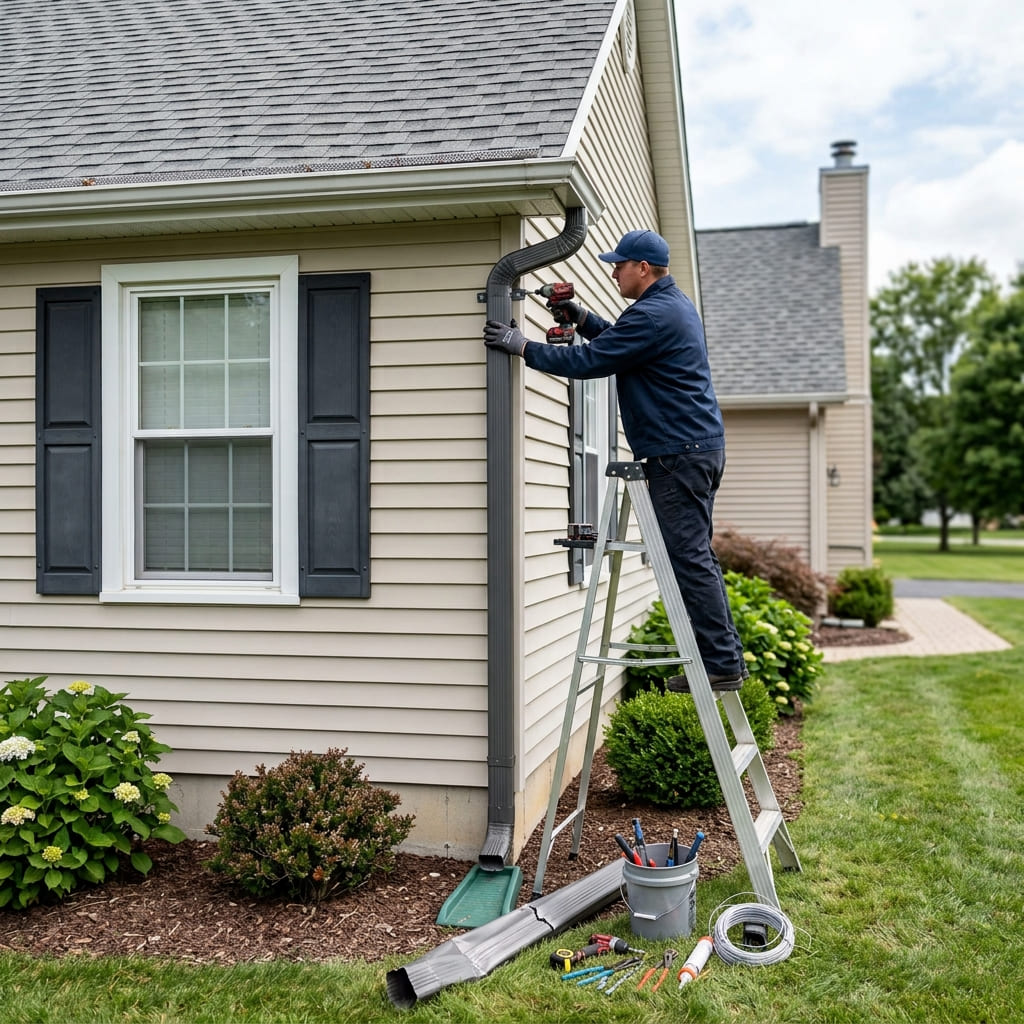
Downspout installation in Boise, ID costs about $8 to $14 per foot in aluminum, and most homes need one downspout for every 30 to 40 feet of gutter. A 180-foot Treasure Valley house therefore needs five or six — a count that builder packages routinely undercut, which is why so many newer homes here overflow at exactly one corner every spring.
Downspouts are the half of the system homeowners think about least and that fails most. A gutter can be perfectly clean, perfectly pitched, and the correct size, and still dump water against the foundation because the downspout is undersized, badly placed, or discharging 18 inches from the wall onto ground that will not take it.
Downspout sizing: 2x3 vs 3x4
Downspout sizing comes down to two standard rectangular profiles, and the difference between them is larger than the numbers suggest. A 2x3 downspout has six square inches of cross section. A 3x4 has twelve — double the capacity, and more importantly, an opening wide enough that pine needles and small twigs pass through instead of bridging across and starting a clog.
Five-inch gutters usually pair with 2x3 downspouts and 6-inch gutters with 3x4. If you are upsizing gutters during a replacement, upsize the downspouts with them — a 6-inch gutter feeding a 2x3 downspout just relocates the bottleneck. Round downspouts, common with half-round and copper systems, are sized by diameter, typically 3-inch or 4-inch.
Downspout placement on Boise homes
Downspout placement decides whether the water leaves the property or circles back to the foundation. Three rules govern it.
First, every gutter run needs a downspout at its low point, because that is where water is going regardless of where you would prefer it. Second, long runs need intermediate downspouts every 30 to 40 feet so water is not traveling the full length of the house before it can exit. Finally, downspouts should land where the ground slopes away — not next to a basement window well, not at the top of a walkway that ices over in January, and not where discharge will run back toward the house.
A Boise-specific placement note: north-facing walls hold ice at grade well into February. A downspout discharging onto a north-side walkway creates a sheet of ice that refreezes every night for weeks. Route those discharges to a side yard or extend them past the walkway.
Downspout extensions, splash blocks, and drainage
Extensions and drainage carry water the last critical distance — from the base of the downspout to ground that can actually absorb it. In the Treasure Valley this matters unusually much, because a lot of the metro sits on caliche hardpan and heavy clay that shed water sideways rather than downward.
Splash blocks
Splash blocks are the minimum option — a concrete or plastic pad that keeps discharge from eroding a hole in the soil and directs it a foot or two out. They stop erosion and they do very little else. On a house with a basement or crawlspace, a splash block alone is not enough.
Above-ground extensions
Rigid or roll-out extensions carry water four to ten feet from the wall. They are inexpensive ($40 to $150 installed), immediately effective, and easy to inspect. The downside is that they are in the way of mowing and get kicked loose. Hinged versions that flip up for mowing solve most of that complaint.
Buried drain lines and pop-up emitters
Buried lines are the permanent solution: solid PVC running underground from the downspout base to a pop-up emitter set at grade downslope, where the emitter lid lifts under pressure and releases the water. Nothing crosses the lawn, and the discharge point can be 20 or 30 feet from the house.
Two specifications matter. Use solid pipe, not perforated corrugated drain line — corrugated pipe collects sediment, crushes under vehicle traffic, and gets invaded by tree roots, and we find failed corrugated runs on Boise properties constantly during gutter replacements. And include a cleanout, because any buried line eventually needs one.
Common downspout problems in the valley
Downspout problems in the Boise metro repeat in a short list, and each has a specific cause.
| Symptom | Cause | Fix |
|---|---|---|
| Downspout clogs repeatedly | 2x3 profile under needle-dropping trees | Upsize to 3x4, or add guards |
| Water backs up at the top of the downspout | Blockage at the first elbow | Flush, or open the elbow to clear it |
| Downspout pulled off the wall | Spring wind, or too few wall straps | Reattach with straps every 8–10 ft |
| Puddle or wet crawlspace at the base | Discharging too close to the foundation | Extensions or a buried line |
| Ice column inside the downspout | Standing water freezing in a blocked line | Clear gutters before the first freeze |
| Buried line no longer takes water | Crushed or root-blocked corrugated pipe | Replace with solid PVC and a cleanout |
Why downspout drainage matters more in the Treasure Valley
Drainage matters here for a reason that has nothing to do with how much rain falls. Boise gets only 11 to 12 inches of precipitation a year, but that water arrives in concentrated bursts — a February thaw releasing a week of accumulated snow in one afternoon, or a July thunderstorm dropping half an inch in twenty minutes.
Then it lands on soil that will not take it. Caliche hardpan and clay layers across much of Ada and Canyon counties absorb water slowly, so discharge spreads laterally at shallow depth — often straight along the footing. That is how a valley home with 11 inches of annual precipitation ends up with a damp crawlspace and efflorescence on a basement wall. Moving the discharge point six to ten feet out is a genuinely cheap fix for a genuinely expensive problem.
The effect is most pronounced in areas with newer construction on former farm ground — Star, Kuna, south Meridian, and Middleton — where lots were graded quickly, landscaping is immature, and lot lines are tight enough that neighboring downspouts discharge toward the same side yard.
Copper and specialty downspouts
Copper downspouts are installed with copper gutter systems and as standalone architectural details. They come in round and rectangular profiles, are soldered at joints rather than sealed, and develop the same brown-to-green patina as the gutters over several years. At $30 to $50 per foot they are a deliberate design decision, most often seen on entry elevations of Eagle custom homes and on North End restorations.
Rain chains are the other specialty option. They look excellent and they work acceptably in light rain, but they are a poor fit for the valley's freeze-thaw pattern — a chain full of ice is heavy, and meltwater running down a chain in winter creates the same walkway ice problem as a badly placed downspout.
Straight answers
Downspout questions
How much does downspout installation cost in Boise?
Downspout work in Boise runs roughly $8 to $14 per foot for aluminum, which puts a standard two-story downspout at about $90 to $200 installed. Copper downspouts run $30 to $50 per foot. Simple extensions and splash blocks are $40 to $150 each. Buried drain lines to a pop-up emitter are priced by trench length and soil — expect several hundred dollars per run in valley hardpan.
How many downspouts does my house need?
The working rule is one downspout per 30 to 40 feet of gutter, plus one at every low point in a run. A 180-foot home therefore needs five or six. Steeper roofs and roof valleys that concentrate two planes into one gutter section need more, not fewer. Builder packages on newer Treasure Valley homes frequently install the minimum, which is why so many two-story homes here overflow at one specific corner.
Should I upgrade from 2x3 to 3x4 downspouts?
Upgrade if you have pine or fir overhead, if a downspout clogs more than once a year, or if you are moving to 6-inch gutters. A 3x4 downspout has roughly twice the cross-sectional area of a 2x3, so it passes needles and small debris that would bridge across the smaller opening and start a blockage. The added cost is a few dollars per foot and it is the single most effective anti-clog change available.
How far from the house should a downspout discharge?
Discharge water at least four to six feet from the foundation, and farther on flat ground. This matters more in the Treasure Valley than in most markets because much of the valley sits on clay and caliche hardpan that absorbs water very slowly. Water dumped 18 inches from the wall on a splash block spreads sideways under the slab instead of soaking in. Extensions or buried lines are the fix.
Are buried downspout drain lines worth it?
They are worth it when the yard is flat, when the soil holds water, or when surface extensions are in the way of mowing and walkways. A buried line carries discharge in solid PVC to a pop-up emitter downslope, where it releases at grade. The two things to insist on: solid pipe rather than corrugated perforated pipe, and a cleanout access. Corrugated line crushed by tree roots is one of the most common hidden failures we find during replacements.
Why does the same downspout keep clogging?
Repeat clogging almost always happens at the first elbow, where the downspout turns toward the wall and the effective opening narrows. Three causes dominate: the downspout is 2x3 on a needle-heavy lot, the gutter outlet above it is undersized, or the gutter itself is pitched so debris collects at that outlet. Clearing it repeatedly treats the symptom — upsizing to 3x4 or correcting the pitch ends it. See gutter repair.
Do you install copper downspouts?
Yes. Copper downspouts are usually installed alongside copper gutters, in round or rectangular profile, and they patina to match over several years. They are also sometimes used alone as an architectural detail on an entry elevation with aluminum elsewhere. Copper downspouts run $30 to $50 per foot and are soldered rather than sealed at joints.
Fix where your water is going
Call about downspout sizing, placement, extensions, or a buried drain line. Free estimate, and we will tell you if a $90 extension solves what looked like a drainage project.