
Gutter profiles
Half-Round Gutters
A smooth semicircular trough on exterior brackets — the historically correct profile for pre-war architecture, and the one that sheds debris best under heavy tree cover.
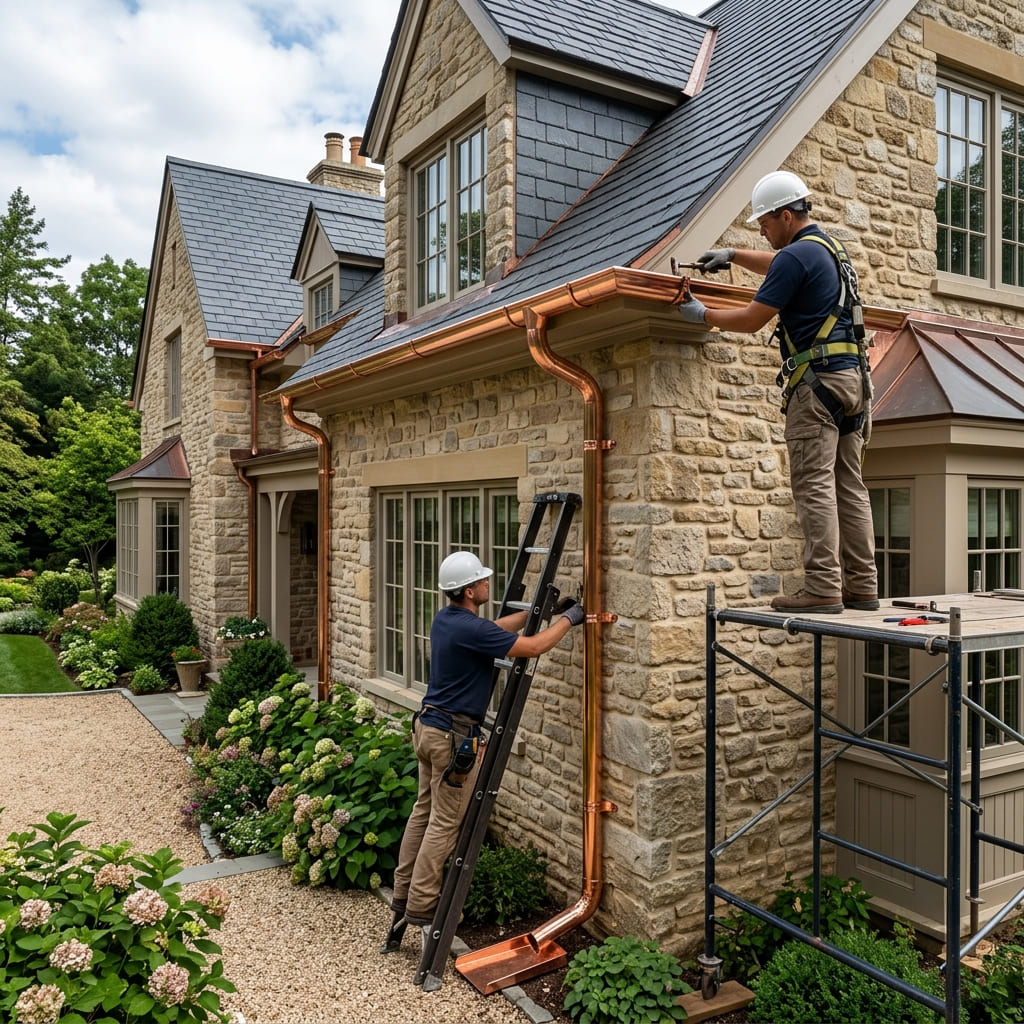
Half-round gutters in Boise install for $12 to $20 per linear foot in aluminum and $30 to $50 in copper. The profile is exactly what the name says — a semicircular trough, hung on exterior brackets rather than mounted flush to fascia — and it was the standard residential gutter in America before K-style displaced it in the mid-20th century.
Half-round is chosen for two reasons in the Treasure Valley, and they are different enough that it is worth knowing which one applies to you. One is architectural correctness on an older home. The other is functional: under heavy debris load, a round trough works better than a square one.
Why half-round sheds debris better
Half-round sheds debris better because it has no interior corners. In a K-style gutter, the flat bottom meets the sides at roughly ninety degrees, and that angle is where leaf matter, shingle granules, and pine needles settle. Water flows over the accumulation rather than lifting it.
In a half-round, every point on the trough is part of a continuous curve. Debris that lands in it tends to be carried along toward the outlet by moving water instead of finding a corner to settle in. It does not eliminate cleaning — nothing does — but it noticeably slows the rate at which a trough packs solid.
That matters in specific Boise locations. Homes under mature cottonwood along the Boise River and through Garden City, properties with ponderosa or fir in the Eagle foothills, and the elm and maple canopy over the North End all produce the kind of sustained debris load where the profile difference is worth money.
The capacity trade-off
Half-round holds less water than K-style at the same nominal width, and this has to be planned for rather than discovered.
A 5-inch K-style is essentially a rectangle five inches across. A 5-inch half-round is a semicircle five inches across, which encloses substantially less area. The practical compensations are straightforward: specify one size larger than you would in K-style, add outlets so water has more exit points along the run, or both.
On a steep Boise roof — above about 6:12 — this matters. Water arrives at the eave fast, and a half-round sized as if it were K-style will overshoot during a hard July thunderstorm. Six-inch half-round with 4-inch round downspouts is the usual specification on those elevations.
Brackets, hangers, and how half-round mounts
Half-round mounts differently than K-style, and the difference is visible. K-style has a flat back that sits against the fascia and accepts hidden hangers inside the trough. Half-round has no flat back, so it hangs in exterior brackets — visible straps or hooks that wrap the trough and fasten to the fascia or, on some historic installations, to the roof deck.
Those brackets are part of the aesthetic. On a Craftsman or Tudor home they read as appropriate hardware. On a contemporary elevation they can look fussy. Bracket spacing follows the same logic as hidden hangers: 24 inches standard, tighter under metal roofs and in snow-load areas.
Half-round materials
- Aluminum half-round ($12–$20/ft) — the practical option. Rustproof, light, available in factory colors, and roll-formed seamlessly. Gets most of the profile's benefits at a manageable price.
- Steel half-round ($15–$25/ft) — stiffer, for properties with sliding snow or falling limbs. Heavier in the brackets, so fascia condition matters more.
- Copper half-round ($30–$50/ft) — the traditional combination and the one most people picture. Soldered joints, 60-plus year life, and a patina that moves from bright penny to deep brown over the first year or two.
Where half-round fits in the Treasure Valley
Half-round shows up in a few identifiable contexts around the Boise metro.
Historic Boise neighborhoods. The North End and East End hold a concentration of 1900s–1930s Craftsman, bungalow, and Tudor homes where half-round is the period-correct profile. On a restoration, the gutter profile is one of the details that either supports the work or undercuts it.
Eagle and foothills custom homes. Copper half-round on a heavy-timber or stone elevation is a deliberate architectural statement, and it pairs naturally with the debris-heavy conifer environment those properties sit in.
Older Canyon County cores. Downtown Nampa, Caldwell, and Middleton all have pre-war housing stock where the same logic applies, often at more modest scale in aluminum rather than copper.
Should you choose half-round?
Choose half-round if your home is pre-war and you care about the profile reading correctly, or if you are under heavy conifer cover and want the debris behavior. Choose K-style if capacity per inch of width is the priority, if the budget is a real constraint, or if the architecture is post-1950 — which describes most of Meridian, Star, and Kuna.
Both profiles work. The failure mode is choosing half-round for the look and then sizing it like K-style, which produces a beautiful gutter that overflows every summer.
Straight answers
Half-round gutter questions
How much do half-round gutters cost in Boise?
Half-round costs more than K-style at every material grade. Aluminum half-round runs $12 to $20 per linear foot installed, steel $15 to $25, and copper $30 to $50. The premium comes from two places: the profile requires exterior brackets rather than hidden hangers, and the round downspouts and fittings that pair with it cost more than standard rectangular components.
Do half-round gutters clog less than K-style?
Yes, and it is the strongest functional argument for the profile. A K-style gutter has interior corners where the bottom meets the sides, and debris packs into them and stays. A half-round has a continuous curve with no corners, so material tends to migrate toward the outlet with the water rather than settling in place. Under mature cottonwood or pine, that difference is genuinely noticeable.
Do half-round gutters hold less water?
Yes. At the same nominal width, a semicircular trough encloses meaningfully less cross-sectional area than a flat-bottomed K-style. The usual compensation is going one size up — a 6-inch half-round rather than a 5-inch — or adding outlets so water has more exit points along the run. On steep roofs this needs to be planned rather than assumed.
Are half-round gutters right for an older Boise home?
Often, yes. Half-round is the historically correct profile for homes built before roughly 1950, which covers a great deal of Boise's North End and East End and the older cores of Nampa, Caldwell, and Middleton. On a Craftsman or Tudor, K-style's crown-molding face can look anachronistic, while a half-round reads correct.
What downspouts go with half-round gutters?
Round downspouts, typically 3-inch or 4-inch in diameter, are the standard pairing and the visually correct one. Rectangular downspouts can be adapted to a half-round outlet but the transition looks improvised. Round downspouts also pass debris slightly better than rectangular for the same cross-sectional area, which complements the profile's debris-shedding behavior.
Can half-round gutters be seamless?
Yes. Half-round is roll-formed from coil the same way K-style is, producing continuous runs cut to eave length. In copper the joints are soldered; in aluminum and steel they are riveted and sealed. Not every contractor carries half-round rollers, so it is worth asking specifically whether a quoted half-round system is seamless or sectional.
Get a half-round gutter quote
We will size it for your actual roof pitch rather than matching K-style dimensions, and quote the brackets and round downspouts as part of the number.