Commercial gutters
Commercial Gutter Services in Boise, ID
Larger systems, larger consequences. Box gutters, 6-inch and 7-inch runs, oversized downspouts, and scheduled maintenance for buildings where overflow means a tenant complaint.
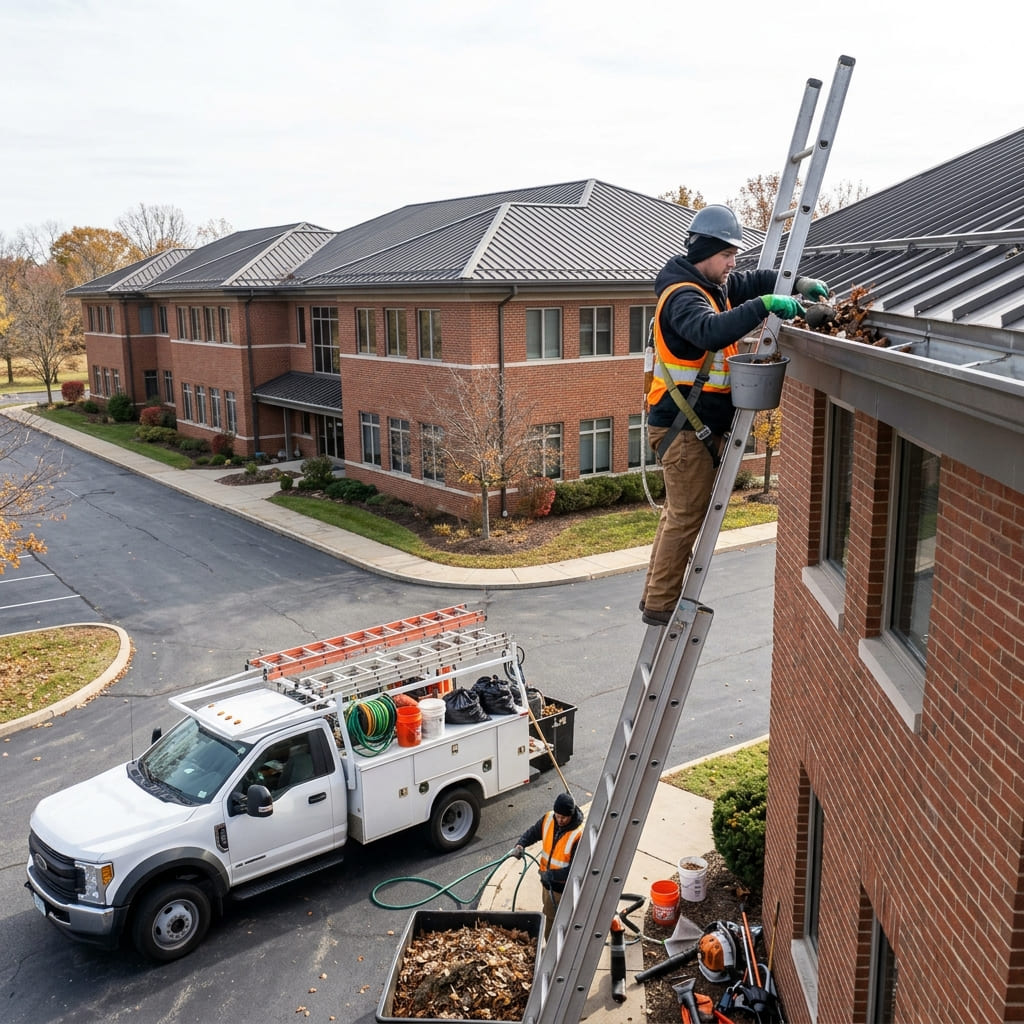
Commercial gutter systems in Boise typically run 6-inch or 7-inch K-style, or custom box gutters, with 3x4 and 4x5 downspouts sized to roof drainage area. We handle installation, repair, replacement, and scheduled cleaning for offices, warehouses, shops, churches, restaurants, and multi-family properties across Ada and Canyon counties.
Commercial gutter work differs from residential in three ways that matter to a budget. The systems are larger and made from heavier-gauge material. Access usually requires lifts or scaffold rather than ladders. And the cost of failure is not a wet crawlspace — it is water over a customer entrance, a slip hazard on a walkway, or intrusion into a leased space with a tenant on the phone.
Commercial gutter systems we install and service
Commercial gutter systems in the Treasure Valley fall into four categories, each with its own sizing logic and failure pattern.
6-inch and 7-inch K-style
Oversized K-style is the workhorse for strip retail, offices, medical buildings, and light industrial. It looks like residential gutter scaled up, uses heavier gauge aluminum or steel, and pairs with 3x4 or 4x5 downspouts. On buildings with long single-plane roofs, outlet count matters more than gutter size — a 7-inch gutter with too few outlets still backs up.
Box gutters
Box gutters are rectangular troughs, usually custom-fabricated from heavier metal, used where standard profiles cannot carry the volume or where the gutter sits concealed behind a parapet wall. Older commercial buildings in downtown Boise, downtown Nampa, and the Indian Creek corridor in Caldwell commonly have them. Their characteristic failure is a seam or corner leak that goes unnoticed because the gutter is not visible from the ground — it shows up first as a stain on an interior wall.
Warehouse and shop buildings
Metal buildings across the valley's industrial areas — Garden City's light-industrial blocks, the Franklin corridor, and the shop buildings on larger Kuna and Middleton parcels — have long uninterrupted eave runs and metal roofs that release snow all at once. Those two facts together demand tight hanger spacing and often snow retention on the roof, because a sliding snow load will tear a gutter off a metal building faster than anything else in this climate.
Multi-family and HOA properties
Apartment buildings, townhome rows, and condo associations are mostly residential-scale gutter repeated many times, which changes the logistics rather than the technique. The work is typically quoted per building or per linear foot across the property, scheduled as a single mobilization, and documented per building so a board or property manager can approve repairs with something specific in hand.
Scheduled commercial gutter maintenance
Scheduled maintenance is the service most commercial properties in Boise should be buying, and the reason is budget predictability rather than gutter performance. A quarterly or twice-yearly schedule costs a known amount and prevents the two failures that generate emergency calls.
- Overflow at an entrance — water sheeting off a gutter above a doorway, which becomes an ice sheet in January.
- Concealed leaks in box gutters — found on a scheduled inspection rather than by a tenant reporting a ceiling stain.
- Blocked outlets on flat or low-slope roofs, where standing water adds structural load.
- Loose hangers after snow load, caught in a spring visit instead of after a section comes down.
- Buildup from adjacent landscaping, especially on properties with mature trees in parking islands.
Each visit produces a written condition report. Repairs get quoted separately rather than performed automatically, so nothing appears on an invoice that was not approved.
Sizing a commercial gutter system correctly
Sizing a commercial system starts from roof drainage area, not building footprint. The calculation combines the roof area feeding each gutter run, the roof pitch, and local rainfall intensity for short-duration storms.
That last factor is the one people get wrong about Boise. Annual precipitation here is low — 11 to 12 inches — so sizing based on annual totals suggests small gutters. But sizing is governed by peak intensity, and a July thunderstorm in the valley can drop half an inch in twenty minutes. A 10,000 square foot roof section receiving that rate is delivering water at a rate that will overwhelm an undersized system regardless of how dry the year is overall.
The common mistake on Boise commercial buildings: adequate gutter size with too few outlets. Gutter capacity is only realized if water can leave the trough. Adding outlets and upsizing downspouts is usually cheaper than replacing the gutter, and it solves more overflow problems than a larger trough would.
Snow, ice, and commercial rooflines
Snow and ice drive most commercial gutter damage in the Treasure Valley, and metal roofs concentrate the risk. When a metal roof warms enough for the snowpack to release, several hundred pounds of snow slides into the gutter in a second or two. Gutters hung at residential spacing shear off.
Three measures address it: hanger spacing tightened to 16 inches or less on metal-roofed elevations, heavier gauge material that resists deformation, and snow retention devices on the roof itself to break the slab of snow into manageable releases. On buildings with entrances below a metal roof plane, snow retention is a safety issue independent of the gutters.
Commercial gutter service across the Boise metro
Commercial coverage runs the full Treasure Valley. That includes downtown Boise's older masonry buildings with concealed box gutters, the industrial and live-work blocks of Garden City, retail and office along the Meridian and Eagle Road corridors, agricultural and processing facilities around Nampa and Caldwell, and the shop and storage buildings that come with larger parcels in Kuna and Star.
Straight answers
Commercial gutter questions
What size gutters do commercial buildings need?
Most commercial buildings in the Boise area need 6-inch or 7-inch K-style gutter, or a custom box gutter, paired with 3x4 or 4x5 downspouts. Sizing is calculated from roof drainage area and local rainfall intensity, not from building square footage. A 12,000 square foot warehouse roof feeding one elevation moves a great deal of water in a short July thunderstorm, and residential 5-inch gutter will not carry it.
Do you offer scheduled commercial gutter maintenance?
Yes. Most commercial properties are best served by quarterly or twice-yearly scheduled cleaning with a written condition report after each visit. Scheduled maintenance is easier to budget than emergency response, and it prevents the failure mode property managers actually care about — overflow above a customer entrance, or water finding its way into a tenant space.
Can you work outside business hours?
Yes. Retail, restaurant, and medical properties usually prefer early morning or after-close work so ladders and equipment are not staged near customer traffic. Warehouse and industrial sites are often more flexible during the day. Scheduling around your operating hours is part of quoting the job, not an upcharge.
Do you handle multi-family and HOA properties?
Yes — apartment complexes, townhome rows, condo associations, and HOA common areas across Ada and Canyon counties. Multi-family work is usually quoted per building or per linear foot across the property, with a single scheduled visit covering all units. Written per-building condition reports make it straightforward for a board or property manager to approve repairs.
What is a box gutter?
A box gutter is a rectangular trough, typically custom-fabricated from heavier-gauge metal, used where standard profiles cannot carry enough water or where the architecture calls for a concealed gutter behind a parapet. Box gutters are common on older commercial buildings in downtown Boise, Nampa, and Caldwell. They hold far more water than K-style and require correspondingly larger outlets.
How much does commercial gutter work cost?
Commercial pricing is quoted per project because the variables are wider than residential. Cleaning is typically priced per linear foot with an access factor for roof height and equipment needs. Installation of 6-inch and 7-inch systems generally runs above residential per-foot rates because of heavier gauge material, larger outlets, and lift or scaffold requirements. Every quote is itemized in writing.
Get a commercial gutter quote
Installation, repair, or a scheduled maintenance contract for your property. Written condition reports, itemized quotes, and work scheduled around your operating hours.