Comparison guide
K-Style vs Half-Round Gutters
One profile carries more water for less money. The other sheds debris better and is the correct look on period architecture. Which one belongs on your Boise home comes down to those two facts.
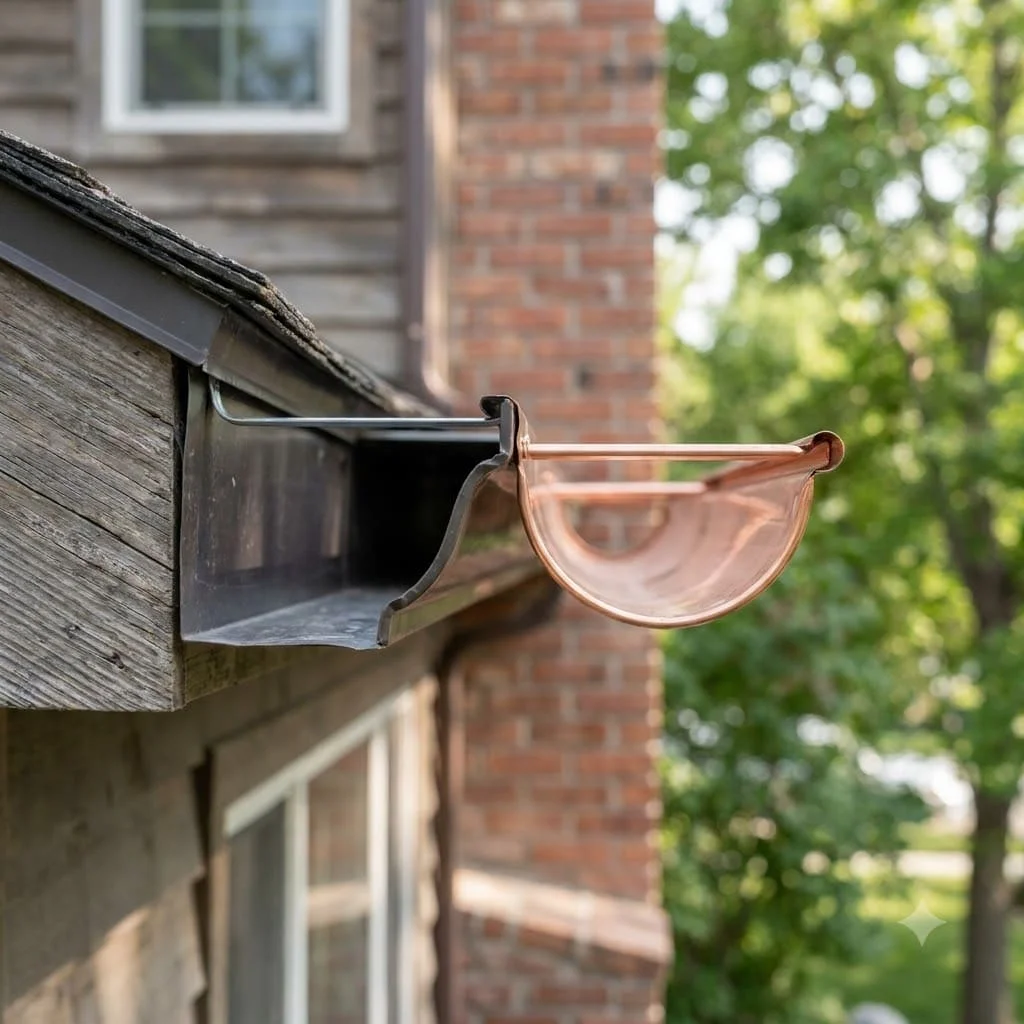
K-style gutters carry more water per inch of width and cost less to install, which is why roughly nine out of ten Idaho homes have them. Half-round gutters shed debris better and suit historic architecture, at $12 to $50 per foot against $8 to $18. Both are available seamless, and both work — they simply solve for different priorities.
The shapes explain everything else. K-style has a flat back and a decorative ogee face that
echoes interior crown molding, so it fastens flat against the fascia and hides its own hangers.
Half-round is a plain semicircular trough that usually hangs from visible brackets under the
roof edge.
Every difference in price, capacity, and clogging behavior follows from those two geometries.
K-style vs half-round gutters at a glance
| K-style | Half-round | |
|---|---|---|
| Profile | Flat back, ogee front, flat bottom | Smooth semicircular trough |
| Installed cost per foot | $8–$18 | $12–$50 |
| Capacity at equal width | Higher — squared section holds more | Lower — semicircle holds less |
| Debris behavior | Interior corner packs with needles and grit | Continuous curve, debris keeps moving |
| Hanging | Hidden hangers screwed through the back | Visible brackets or straps |
| Cleaning | Corner needs scraping | Wipes out with a rounded scoop |
| Ice behavior | Force concentrates on flat bottom and front lip | Curved wall spreads outward pressure |
| Materials | Aluminum, steel, copper, vinyl | Aluminum, steel, copper, zinc |
| Look | Reads as trim, disappears on modern homes | Visible architectural element |
| Best for | Most Treasure Valley homes | Period homes, high-end builds, heavy needle load |
Capacity: why K-style wins on paper
Take a 5-inch K-style and a 5-inch half-round. The K-style holds more water, because a shape with a flat bottom and near-vertical walls encloses more area than a half circle of the same opening width.
That is why a home that needs serious capacity is usually better served by moving to
6-inch K-style than by going half-round.
If you want half-round on a roof with real volume, expect to specify 6-inch half-round and 3x4
downspouts to get back to where 5-inch K-style already was — which is part of why half-round
projects cost more.
Debris: why half-round wins in practice
The paper advantage flips once you account for what is actually in the trough. A gutter is only as large as its unobstructed cross-section, and K-style loses part of its section to packed debris in that interior corner.
In the Boise foothills — Warm Springs Mesa, the Highlands, Collister, Hidden Springs — ponderosa
needles fall year-round and mat into a dense fibrous plug that water cannot push through. Along
the Boise River greenbelt through Garden City and
Eagle, June cottonwood fluff does the same thing.
Half-round's continuous curve gives that debris nowhere to wedge, so more of it reaches the
outlet and leaves the system.
Neither profile removes the need for maintenance. What half-round buys is a longer interval between cleanings on a needle-heavy lot, which on a two-story foothills home at $125 to $350 per visit is a real recurring saving. See gutter cleaning cost.
Hangers matter more than profile. Whichever shape you choose, hidden hangers screwed into the fascia at 24-inch spacing will outperform spike-and-ferrule at 36 inches by a wide margin through Treasure Valley freeze-thaw cycles. Ask about hanger type and spacing on any quote before you compare bottom-line numbers.
Architecture: where each profile belongs in the Boise area
Profile is one of the few gutter decisions that is genuinely visible from the street, so architecture carries real weight here.
- Boise North End and East End — Craftsman, Tudor, and early bungalow homes were built with half-round, usually in galvanized or copper. Half-round is the historically correct restoration answer, and copper half-round on exposed rafter tails is the classic detail.
- Post-1980 subdivisions in Meridian, Kuna, Star, and Middleton — K-style. The ogee face was designed to look like trim against this kind of fascia, and it reads as part of the roofline rather than an addition.
- Eagle and foothills custom builds — either, depending on style. Half-round in copper suits heavy timber and stone; K-style suits contemporary flat-fascia designs.
- Modern and modern-farmhouse builds — half-round has come back in fashion here in aluminum and Corten, where the round profile and visible straps are treated as a design feature rather than hidden.
- Downtown Nampa and Caldwell historic cores — half-round is often the period-appropriate choice on pre-war homes, though K-style is what most have now.
- Rentals, outbuildings, and shops — K-style, in aluminum. Lowest cost per foot of capacity, simplest to fasten, easiest to source parts for.
What each profile costs and why
K-style installs for $8 to $18 per linear foot depending on material and gauge. Half-round runs $12 to $50. Two things drive the gap.
Material mix. Half-round is disproportionately ordered in copper at $25 to $45 per foot and in zinc, because the people choosing it are usually choosing it for looks. Aluminum half-round exists and sits near the bottom of the range.
Hanging labor. K-style screws flat to the fascia through its own back. Half-round needs brackets set at correct spacing and consistent pitch, which is slower and less forgiving. With Idaho gutter labor around $61 per hour, that time shows up on the invoice.
For reference, a complete gutter system in Idaho averages $2,705 to $3,660 — that figure assumes K-style aluminum, and a half-round copper system on the same house can be several times it.
Choosing between them
Start with the house. If the architecture calls for half-round — genuine period detailing, exposed rafter tails, a restoration you are trying to get right — that answer is already settled, and the rest is choosing a material.
If the architecture is neutral, choose K-style and put the money into gauge, hanger spacing, and
correct sizing instead. Those three things affect how the system performs far more than profile
does.
The exception is a heavily needle-loaded lot where you are cleaning three times a year — there,
half-round in aluminum is worth pricing against K-style plus
gutter guards.
Boise Gutter Service can quote both profiles against your measured eave lengths, including hanger type and spacing, so the comparison is against real numbers. Detail on each profile is on the K-style gutters and half-round gutters pages.
Straight answers
K-style vs half-round gutter questions
What is the difference between K-style and half-round gutters?
K-style gutters have a flat back and a decorative ogee front that mimics crown molding. Half-round gutters are a smooth semicircular trough, essentially a tube cut in half. The flat back lets K-style fasten directly to fascia, while half-round usually hangs from brackets. At the same nominal width, K-style carries noticeably more water because the squared profile holds more volume than a semicircle.
Are half-round gutters better than K-style?
Better at some things, worse at others. Half-round sheds debris more readily because there is no interior corner for needles and grit to pack into, and it is the historically correct look on period architecture. K-style carries more water per inch of width, costs less, and fastens more simply. On a typical Boise subdivision home K-style is the right choice; on a North End Craftsman restoration half-round often is.
How much do half-round gutters cost in Boise?
Half-round runs $12 to $50 per linear foot installed depending on material, against $8 to $18 for K-style. Aluminum half-round sits at the low end of that range and copper half-round at the top. The spread is wide because half-round is most often ordered in premium materials, and because bracket hanging takes longer than screwing a K-style back directly to fascia.
Do half-round gutters clog less?
They clog less readily, yes. A K-style trough has an interior corner where the flat bottom meets the back, and pine needles, cottonwood fluff, and roof grit pack into it. A half-round has continuous curvature, so debris tends to keep moving toward the outlet with the water. It clogs less — it does not clog never, and foothills homes still need regular cleaning.
Which profile is better for Boise snow and ice?
Half-round has a mild advantage. Ice expanding inside a round trough pushes outward evenly against a curved wall, while ice in a K-style trough concentrates force on the flat bottom and the front lip, which is where seams open. That said, hanger type and spacing matter far more than profile — hidden hangers every 24 inches beat any profile hung badly.
Can half-round gutters be seamless?
Yes. Half-round roll-forms from coil the same way K-style does, so continuous runs cut to your exact eave length are available in aluminum, steel, and copper. Copper half-round is typically soldered at the joints rather than sealed, which is a major reason those systems last 60-plus years. See seamless gutters.
Get a gutter profile quote in Boise
Written pricing for K-style and half-round on your roofline, with material and hanger options laid out — at no charge.