
Comparison guide
5-Inch vs 6-Inch Gutters for Idaho Homes
Most Treasure Valley homes are correctly served by 5-inch. A specific set of rooflines is not — and those are the houses where overflow keeps happening no matter how often the gutters get cleaned.
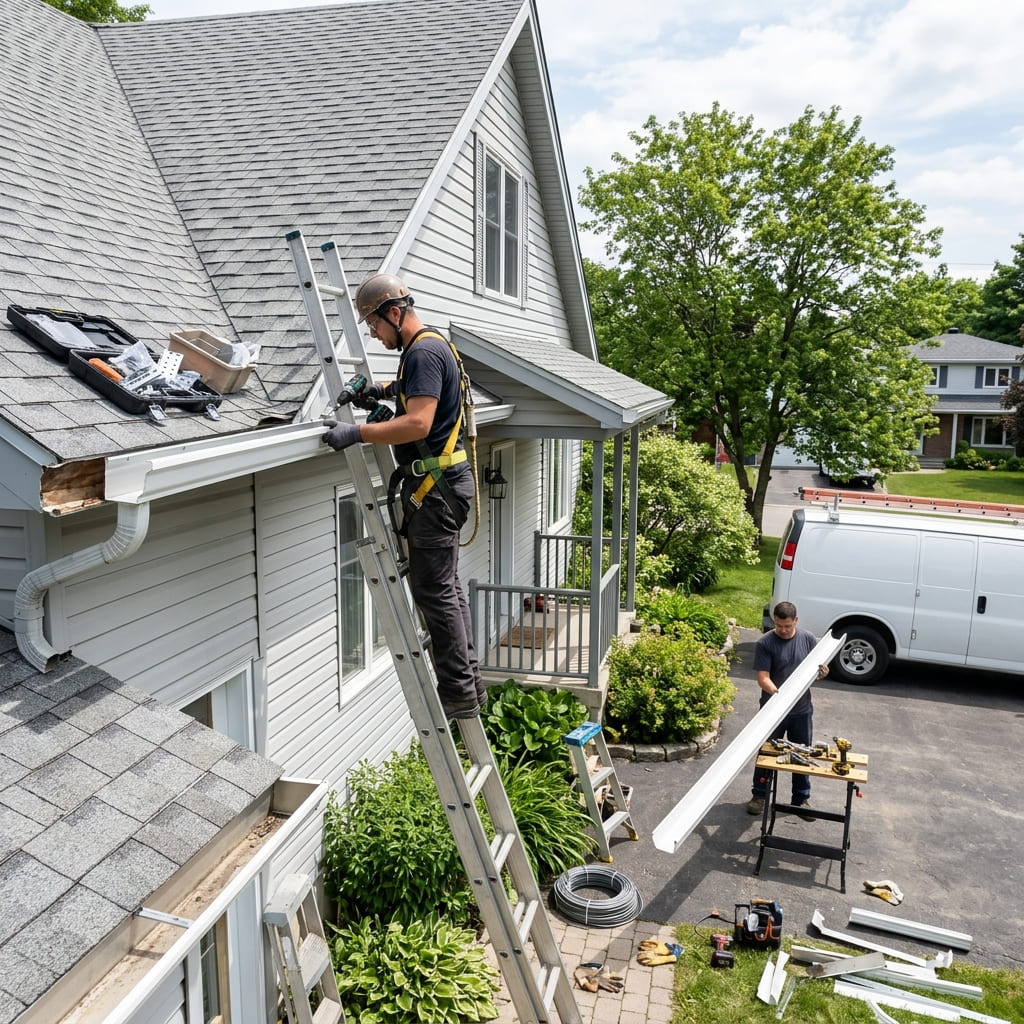
5-inch K-style gutters are the right size for most homes in Boise. 6-inch gutters are worth the 10% to 20% upcharge when a roof concentrates a lot of water into a short length of gutter — steep pitches, runs over 40 feet, valleys emptying into one section, or metal roofing that dumps its snow all at once.
The trough itself is only half the story. Going to 6-inch also unlocks
3x4 downspouts in place of the standard 2x3, and that outlet size is where the
real capacity gain lives.
A 2x3 downspout has roughly 6 square inches of cross-section; a 3x4 has about 12. Doubling the
outlet does more for a chronically overflowing roofline than widening the trough does.
5-inch vs 6-inch gutters at a glance
| 5-inch K-style | 6-inch K-style | |
|---|---|---|
| Trough capacity | Baseline | Roughly 40% more |
| Standard downspout | 2x3 (~6 sq in) | 3x4 (~12 sq in) |
| Installed cost per foot | $8–$16 aluminum | Roughly $9–$19 aluminum |
| Clogging behavior | Needles and fluff bridge the trough sooner | Wider trough, debris moves further before jamming |
| Ice and snow | Overtops earlier, 2x3 freezes solid easily | More volume before overtopping, 3x4 harder to block |
| Appearance | Visually recessive on most homes | Noticeably heavier line on small elevations |
| Fascia requirement | Works on most existing fascia | Needs sound fascia and enough drip-edge clearance |
| Best for | Most Treasure Valley homes | Steep roofs, long runs, valleys, metal roofing |
What actually determines the size you need
Gutter sizing is not about how much rain your city gets. It is about how much water arrives at one point of gutter, how fast. Three variables drive that.
1. Drainage area
The roof surface feeding one downspout is the primary number. A rough working rule is that a
2x3 downspout comfortably serves somewhere around 600 square feet of roof, while a 3x4 serves
roughly double that.
Homes with large uninterrupted roof planes — common on newer builds in
Star, Kuna, and south
Meridian — frequently exceed that per outlet, which is why adding a
downspout is sometimes a cheaper fix than resizing the whole system.
2. Roof pitch
A steep roof does not collect more rain than a shallow one of the same footprint, but it delivers what it collects much faster and with more momentum. Water coming off a 10:12 pitch arrives with enough speed to shoot straight over the front lip of a 5-inch trough.
This is the most commonly missed factor on Boise foothills homes and on the steep entry gables builders like on two-story houses. If your gutters overflow in a hard summer thunderstorm but are perfectly clean, pitch is usually the culprit rather than debris.
3. Valleys
A roof valley funnels two planes into one narrow stream and dumps it into a short section of
gutter. That section can be receiving several times the water per foot that the rest of the run
sees.
Complex rooflines with multiple valleys are exactly where 6-inch, or a strategically placed
extra outlet under the valley, earns its money.
Before upsizing, check the pitch of the run itself. A gutter needs about a quarter inch of fall per 10 feet toward the outlet. A dead-level or back-pitched run will pond and overflow at any size, and repitching an existing run is far cheaper than replacing it. See gutter repair.
Boise conditions that push a home toward 6-inch
Boise averages only 11 to 12 inches of precipitation a year, which is why 5-inch is adequate on so many houses here. The cases that break it are local and specific.
- Metal roofing. Standing seam and corrugated panels release accumulated snow in one sheet rather than melting it away gradually. A 5-inch trough with 2x3 outlets is the wrong receiver for that event. Pair 6-inch with snow retention on the roof — see aluminum vs steel gutters.
- Summer thunderstorm bursts. The valley gets much of its warm-season rain in short high-intensity cells. Annual totals are low; the peak rate during those twenty minutes is not, and peak rate is what sizes a gutter.
- Freeze-thaw ice in the trough. A 2x3 downspout that ices closed turns the whole run into a trough of standing water, then a trough of ice. A 3x4 is meaningfully harder to block and drains faster during a midday thaw.
- Ponderosa needles and cottonwood fluff. Foothills roofs and greenbelt-adjacent homes in Garden City and Eagle load troughs with debris that mats rather than floats. A wider trough buys tolerance between cleanings, though it does not replace them — see gutter guards vs cleaning.
- Two-story homes on tight lots. Much of Meridian and Nampa is built this way. Overflow from a second-story gutter lands directly on the foundation because there is no room for it to disperse, which raises the cost of getting sizing wrong.
- Hardpan and clay soils. Around Kuna and parts of Canyon County, water that overflows does not soak away. It sits against the foundation, which makes downspout capacity and extension placement more important than the trough size alone. See downspouts and drainage.
When 5-inch is the right call
Most of the time. Choose 5-inch when your home has moderate roof pitch, runs under about 40 feet, a simple roofline without valleys concentrating flow, and asphalt shingles rather than metal.
There is also an appearance argument. A 6-inch trough is a visibly heavier line, and on a small
single-story ranch or a cottage in the Boise North End it can look out of proportion with the
fascia it sits on.
If capacity is not the problem, the larger gutter is just a larger gutter.
The cheaper alternative to upsizing
Before committing to a full resize, it is worth pricing the two fixes that solve most overflow problems for far less money.
Add a downspout. Splitting a long run so it drains at both ends halves the distance water has to travel and halves the load on each outlet. On a chronically overflowing 40-foot run, this often solves the problem outright.
Upgrade the outlets only. On some installations the existing 5-inch trough can accept larger outlets and 3x4 downspouts. Since the outlet is usually the bottleneck, this captures most of the benefit of a 6-inch system for a fraction of the price.
Which of these applies depends on your roof, and it is the kind of thing that has to be looked at rather than guessed. Boise Gutter Service can walk the roofline, count the drainage areas per outlet, and give you written pricing for 5-inch, 6-inch, and the add-a-downspout option so you can see all three numbers before deciding. Profile options are covered on the K-style vs half-round page, and the full install process is on gutter installation.
Straight answers
5-inch vs 6-inch gutter questions
Are 6-inch gutters worth it in Boise?
They are worth it on specific rooflines, not on every house. Upsizing costs roughly 10% to 20% more installed, and it buys about 40% more trough capacity plus the ability to run 3x4 downspouts. If your roof has steep pitches, long runs over 40 feet, valleys dumping into one section, or metal roofing, 6-inch pays for itself the first time you do not have to clean up an overflow. On a simple single-story ranch, 5-inch is correct and 6-inch is overspending.
How much more water does a 6-inch gutter hold?
A 6-inch K-style trough carries roughly 40% more water than a 5-inch trough of the same profile. The bigger gain is at the downspout: a 3x4 outlet has about twice the cross-sectional area of a 2x3, so it moves close to double the volume. In practice the downspout upgrade matters more than the trough upgrade, because outlets are where most overflow actually starts.
What size gutters do most Boise homes have?
5-inch K-style with 2x3 downspouts is the standard on the great majority of Treasure Valley homes, including most subdivision construction in Meridian, Kuna, Star, and Nampa. It is what builders specify because it handles typical Boise rainfall comfortably. 6-inch shows up on custom builds, steep-roofed foothills homes, and buildings with large single-plane roof areas.
Can I put 6-inch gutters on a house that has 5-inch now?
Usually yes. The limits are fascia condition and the roof edge detail — a 6-inch trough is wider and taller, so it needs a fascia board in good shape and enough room under the drip edge to sit at the right height without catching shingle runoff behind it. On older Boise homes with damaged fascia, the fascia repair is often the bigger line item. See gutter replacement.
Do 6-inch gutters handle ice better?
They handle ice differently rather than better. A 6-inch trough holds more volume before it overtops, and a 3x4 downspout is much harder to freeze solid than a 2x3. But no gutter size prevents ice damming — that is a roof insulation and ventilation problem, not a gutter problem. Upsizing reduces overflow; it does not stop ice forming at the eave.
How much do 6-inch gutters cost in Boise?
Seamless aluminum in 5-inch runs $8 to $16 per linear foot installed. 6-inch typically adds 10% to 20%, so roughly $9 to $19 per foot, with 3x4 downspouts costing more than 2x3 as well. On a 180-foot home the upgrade usually lands somewhere between $250 and $600. Full numbers are on the gutter installation cost page.
Not sure what size your roof needs?
Get your drainage areas checked and written pricing for both sizes on your actual roofline — no charge, no obligation.