
Gutter installation
Seamless Gutter Installation Cost & Process in Boise
Seamless aluminum, galvanized steel, and copper systems formed to your exact eave length, hung on hidden hangers, pitched with a level, and outlet-placed so water actually leaves the building.
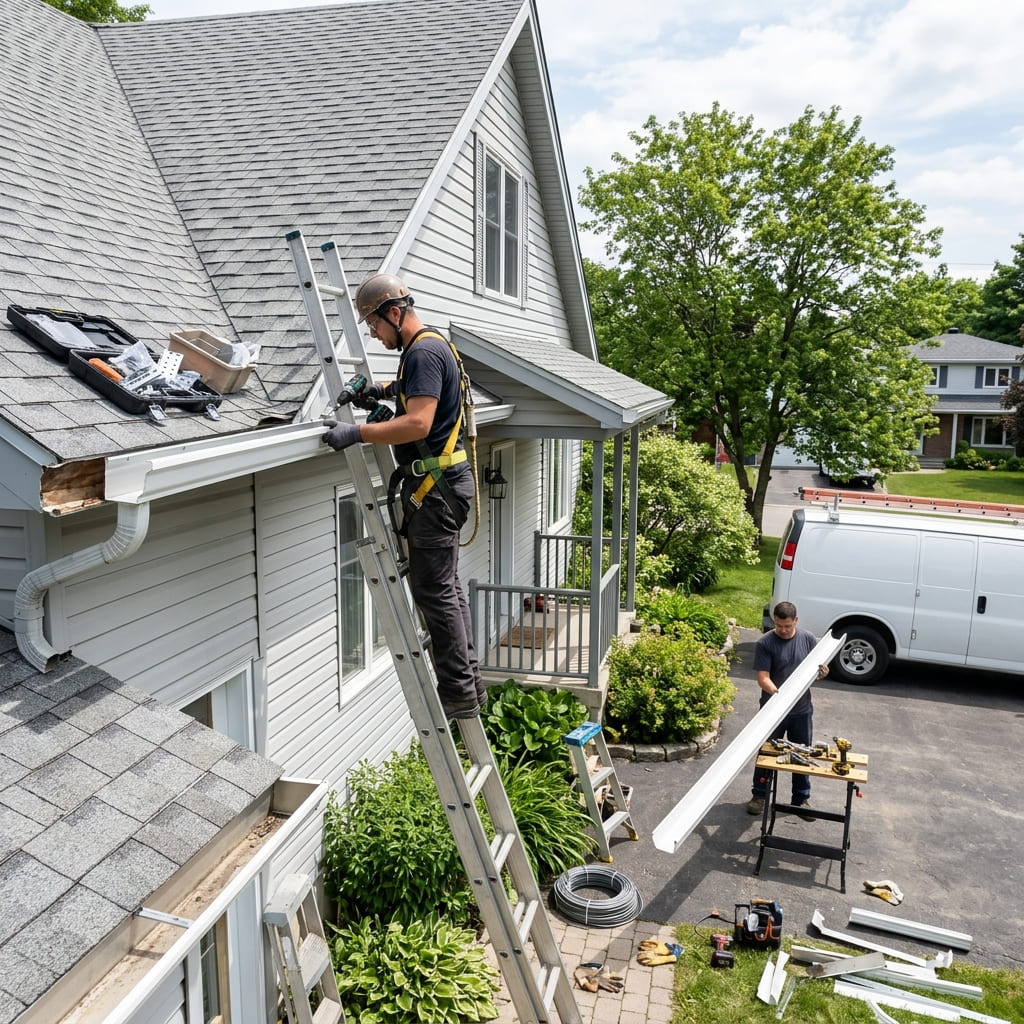
Gutter installation in Boise, ID runs $8 to $16 per linear foot for seamless aluminum, and a complete Idaho home system averages $2,705 to $3,660. A typical Treasure Valley house needs 150 to 200 feet of gutter and four to six downspouts, formed on site and installed in a single day.
A gutter installation is mostly a water-math problem wearing a carpentry costume. The trough has to be large enough for the roof area draining into it, pitched enough to move water without looking crooked from the street, fastened often enough to survive snow load, and pointed at downspouts placed where the water can actually get away from the foundation. Get those four right and the system lasts decades. Get any one wrong and you get overflow, standing water, or a gutter that peels off the fascia in the first hard February.
Seamless vs sectional gutter installation
Seamless installation forms one continuous gutter for each eave run, which is why it has largely replaced sectional systems on Boise homes. Sectional gutter comes in 10-foot lengths from a big-box store and joins with slip connectors and sealant. Every one of those joints is a hinge point and a future leak, and Boise's freeze-thaw cycling works sealant loose faster than a milder climate would.
Seamless aluminum arrives as a coil and runs through a truck-mounted roll former at your curb, so a 45-foot eave gets a single 45-foot gutter. The only joints in the finished system are at corners, end caps, and downspout outlets — all of which get sealed and are easy to inspect. Sectional still has a place on small detached buildings and short runs where the cost of mobilizing a forming truck outweighs the benefit. Details are on the seamless gutters page.
Gutter materials for Treasure Valley homes
Gutter materials in the Treasure Valley come down to three practical choices, plus two specialty options for specific architecture.
| Material | Installed cost/ft | Service life | Best for |
|---|---|---|---|
| Aluminum | $8 – $16 | 20–30 years | The default — light, rustproof, seamless, 25+ colors |
| Galvanized steel | $10 – $18 | 15–25 years | Ladder traffic, falling branches, sliding snow |
| Copper | $25 – $45 | 60+ years | Historic North End homes, Eagle custom builds |
| Corten steel | $20 – $35 | 40+ years | Modern-rustic foothills architecture |
| Vinyl | $4 – $8 | 5–15 years | Sheds and outbuildings only — it embrittles in Boise UV and cold |
For most Boise homes, seamless aluminum in .027 or .032 gauge is the correct answer. Thicker .032 aluminum costs slightly more and resists denting from ladders and hail noticeably better, which matters on a house where the gutters also serve as the ladder rest twice a year.
Gutter profiles: K-style and half-round
Gutter profile changes both capacity and appearance. K-style — the ogee profile with a flat back and a decorative front face — is on roughly nine out of ten Idaho homes. Its flat-bottomed cross-section carries more water than a half-round of the same nominal width, and its flat back mounts directly to fascia. See K-style gutters.
Half-round is a true semicircular trough hung on brackets. It carries less water per inch of width but sheds debris better because there are no interior corners for sludge to pack into, and it is the historically correct profile for older Boise architecture and for copper. See half-round gutters.
Gutter sizing: 5-inch vs 6-inch in Boise
Gutter sizing in Boise is decided by roof area and roof pitch, not by house square footage. A 5-inch K-style gutter with 2x3 downspouts handles a moderate single-story roof comfortably. Go to 6-inch with 3x4 downspouts when any of these apply.
- Roof pitch above 6:12 — water arrives at the eave faster and can overshoot a narrow gutter.
- An unbroken run longer than about 40 feet with a single outlet.
- A valley that dumps two roof planes into one section of gutter.
- Metal roofing, common on foothills and Eagle-area homes, where snow releases in sheets.
- Heavy pine or fir cover, where 3x4 downspouts pass needles that would bridge in a 2x3.
The upgrade from 5-inch to 6-inch typically adds $2 to $4 per linear foot. On a 180-foot house that is a few hundred dollars against a 40% capacity gain, and it is the single most common upgrade worth taking.
Downspout planning
Downspout planning decides whether the system works or just looks finished. The rule of thumb is one downspout per 30 to 40 feet of gutter, and one at every low point in the run. Beyond count, placement matters: a downspout is only useful if the water it delivers has somewhere to go.
This is where valley soil becomes the deciding factor. Much of the Boise metro sits on clay and caliche hardpan that absorbs water slowly. A downspout dumping onto a splash block 18 inches from the wall is putting water exactly where you do not want it. Extensions carrying discharge six to ten feet out, or a buried drain line to a pop-up emitter downslope, is what actually protects the foundation. Full detail on downspouts and drainage.
Pitch and hanger spacing — the two details that fail
Pitch and hanger spacing are where cheap installations give themselves away, and both are invisible from the street until something goes wrong.
Pitch should be about a quarter inch of fall per 10 feet toward the outlet. Too little and water stands in the trough, breeding mosquitoes in summer and freezing into a solid block in winter. Too much and the gutter visibly slopes against the fascia line. Pitch gets set with a level and a chalk line, never by eye.
Hangers should be hidden hangers screwed into rafter tails at 24-inch spacing — tighter, 16 to 18 inches, in snow country and under metal roofs. The old spike-and-ferrule method drives a nail through the gutter face into the fascia, and every Boise freeze-thaw cycle backs that nail out a little further. If your existing gutters show nail heads on the front face, that is why the run sags.
New construction vs replacement installations
New construction installations are straightforward: bare fascia, clean measurements, and full freedom on downspout placement. The main decision is whether to accept the builder's base-grade package. Production builders in Meridian, Star, and Kuna typically install 5-inch aluminum with 2x3 downspouts and the minimum outlet count — adequate, but frequently undersized for a steep two-story roofline.
Replacement installations add tear-off, disposal, and fascia repair, and they carry a constraint new builds do not: existing downspout drainage. If the previous system dumped into a buried line, that line needs testing before the new downspouts get tied into it. Old corrugated drain lines crushed by tree roots are a common and unwelcome discovery. See gutter replacement for the full process.
What drives gutter installation cost
Installation cost tracks five variables, in roughly this order of impact.
- Linear footage — the base of every quote. Most Boise homes run 150–200 feet.
- Material — copper costs three times aluminum for the same run.
- Corners and outlets — each inside or outside corner is fabricated and sealed by hand.
- Stories and access — second and third-story runs need more setup and staging time.
- Fascia condition — rotted board discovered at tear-off has to be replaced before hanging.
See the installation cost guide for per-foot pricing by material, or the gutter cost overview for how installation compares to cleaning, repair, and guards.
How it works
The installation process, start to finish
Four stages on a typical single-family gutter installation in the Treasure Valley.
- Step 1
Measure and design
Eave lengths, inside and outside corners, roof pitch, and roof square footage per run get measured. That determines gutter size, outlet count, and where downspouts have to land to actually move the water.
- Step 2
Tear-off and fascia check
Old gutters come down and the fascia board gets inspected while it is exposed. Soft or rotted fascia gets repaired or replaced before anything new is hung — hanging a new gutter on bad wood guarantees a callback.
- Step 3
Form the run on site
Aluminum coil feeds through a roll former and comes out as one continuous gutter cut to your exact eave length. Corners are fabricated, end caps sealed, and outlets punched where the downspouts will go.
- Step 4
Hang, pitch, and test
Hidden hangers screw into rafter tails every 24 inches, the run is set to fall about a quarter inch per 10 feet toward the outlet, then the whole system is water-tested before we leave.
Straight answers
Gutter installation questions
How much does gutter installation cost in Boise?
Gutter installation in Idaho averages $2,705 to $3,660 for a complete home system. Per foot, seamless aluminum runs $8 to $16 installed, galvanized steel $10 to $18, and copper $25 to $45. A typical Boise home needs 150 to 200 linear feet plus four to six downspouts. Labor in this market averages around $61 per hour. Full detail is on the gutter installation cost page.
How long does gutter installation take?
Most Boise homes are done in one day — typically six to nine hours including tear-off, fascia inspection, forming, hanging, sealing, and downspout placement. Homes with many corners, three-story sections, or fascia that needs replacing run into a second day. Weather can also add a day, since gutter sealant needs surfaces above roughly 40°F to cure correctly.
Should I get 5-inch or 6-inch gutters in Boise?
Five-inch K-style handles the majority of single-story Treasure Valley homes. Choose 6-inch when you have a steep roof, a run longer than about 40 feet, a valley dumping two roof planes into one gutter, or a metal roof in the foothills where snow releases all at once. Six-inch carries roughly 40% more water and pairs with 3x4 downspouts, which clog far less than 2x3 on needle-heavy lots.
Are seamless gutters worth it over sectional?
Yes, for almost every home. Sectional gutters join every 10 feet, and every joint eventually leaks as sealant ages through Boise freeze-thaw cycles. Seamless runs have joints only at corners and outlets. The material cost difference is small — the labor to come back and reseal a sectional system repeatedly is not. See seamless gutters.
Can you install gutters on a house that never had them?
Yes, and it is common in the valley — plenty of older Boise homes and outbuildings were built without gutters on the assumption that a dry climate made them unnecessary. New installation on a bare fascia is usually simpler than a replacement because there is no tear-off. The critical work is deciding downspout placement, since there is no existing drainage path to inherit.
What color gutters can I get?
Aluminum coil comes in 25-plus baked-on factory colors, so gutters can match either fascia trim or roof. The most common Treasure Valley choices are white, almond, musket brown, and dark bronze. Baked enamel finishes hold up well against Boise UV at 2,700 feet of elevation, which is harder on paint than most people expect. Copper and Corten steel are left unpainted to patina.
Do I need gutters on every side of the house?
Not always. Gutters matter most where a roof plane drains toward a foundation, a walkway, a door, or a driveway. A gable end with no eave overhang and open ground below can sometimes be left alone. What you should never skip is the side above an entry, above a patio, or on any wall with a basement or crawlspace behind it — that is where water intrusion actually happens in Boise.
Get a free gutter installation quote
Measured footage, material options, downspout placement, and a total — in writing, before anything is ordered or scheduled.