
Gutter guards & leaf guards
Gutter Guards in Boise, ID
Micro-mesh, mesh, screen, and reverse curve compared honestly — including which type actually handles Boise cottonwood fluff, elm seed, and foothills pine needles.
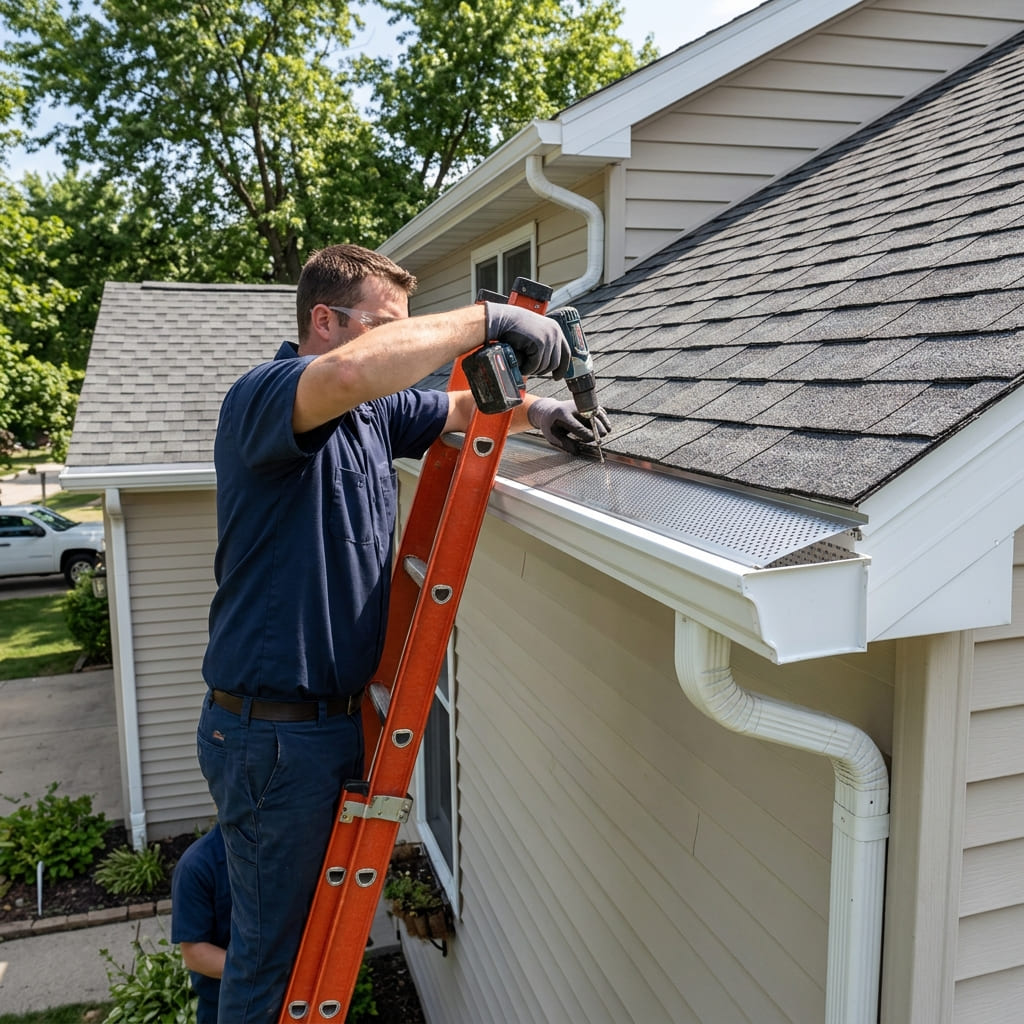
Gutter guards in Boise, ID cost $6 to $25 per linear foot installed, which puts a typical 180-foot home between roughly $1,080 and $4,500. That range is wide because "gutter guard" describes six genuinely different products, and four of them do not work well under the trees most Treasure Valley homes actually have.
Leaf guards are the most oversold product in the gutter business. The pitch is that you will never clean gutters again. The reality is that a good guard eliminates the ladder work of scooping wet leaf sludge twice a year, and replaces it with brushing a mesh surface every year or two. That is a real improvement — it is just not the promise on the truck.
Gutter guard types compared
Gutter guard types differ in what they block, what they pass, and how they fail. Here is the honest comparison for Boise conditions.
| Guard type | Installed cost/ft | Stops | Fails on |
|---|---|---|---|
| Micro-mesh | $12 – $25 | Leaves, needles, seed, most grit | Surface film from pollen and dust if never rinsed |
| Mesh | $6 – $12 | Leaves, twigs, larger debris | Pine needles and cottonwood fluff push through |
| Screen (aluminum or steel) | $3 – $8 | Leaves and twigs only | Needles wedge in openings; screens blow loose in wind |
| Reverse curve | $15 – $30 | Leaves, using surface tension | Heavy downpours overshoot; needles ride the curve in |
| Foam insert | $2 – $5 | Large debris briefly | Degrades in UV, holds moisture, grows seedlings inside |
| Brush insert | $3 – $6 | Large leaves briefly | Traps debris in the bristles — makes cleaning harder |
Micro-mesh
Micro-mesh uses a fine stainless or aluminum screen — openings measured in thousandths of an inch — bonded to a rigid frame. It is the only guard type that reliably stops pine needles, cottonwood fluff, and elm seed, which makes it the right answer for most of the Boise metro. The tradeoff is surface maintenance: fine dust and pollen build a film that eventually sheds water over the edge, so the surface needs a rinse or brush every year or two. Stainless mesh holds up better than plastic-framed versions, which embrittle in valley UV.
Mesh
Standard mesh guards have larger openings than micro-mesh — perforated aluminum or coarse screen. They handle maple, ash, and sycamore leaves well at roughly half the price. They do not handle needles or cottonwood fluff, both of which are extremely common here. Mesh is a reasonable choice on a deciduous-only lot with no conifers within falling distance.
Screen
Screen guards are the least expensive real option and the most commonly installed by homeowners. Aluminum screen that clips into the gutter blocks whole leaves and twigs and nothing smaller. In the valley the recurring problem is wind: screens that only rest in place lift out during spring wind events and end up in the yard. If you go this route, use screens that fasten mechanically rather than friction-fit.
Reverse curve
Reverse curve — also called surface tension or helmet-style — uses a solid cover that curves back into a narrow slot, relying on water clinging to the curve while debris falls past. It is effective on large leaves and it is the most visible from the ground, since it changes the roofline profile. Two Boise-specific weaknesses: heavy summer thunderstorm bursts can overshoot the slot entirely, and pine needles are small enough to follow the water right in.
Foam and brush inserts
Foam wedges and brush inserts drop into the gutter without any mounting hardware, which is their entire appeal. Both are worth skipping. Foam holds moisture against the gutter, degrades under UV, and reliably grows maple seedlings inside itself within two seasons. Brush inserts trap debris in the bristles, so instead of scooping a trough you are pulling out and cleaning a long dirty brush. Neither is a durable solution in this climate.
Are gutter guards worth it in Boise?
Whether gutter guards are worth it in Boise depends almost entirely on what is growing above your roofline. The math is straightforward.
Two cleanings a year at $150 to $300 each is roughly $300 to $600 annually. Quality micro-mesh on a 180-foot home costs $2,200 to $4,500 installed. That is a six to ten year payback if guards eliminate both visits, and longer in practice because you will still want the system checked periodically. Guards make clear financial sense when the debris load is heavy enough that you are cleaning three times a year, or when access is difficult enough that cleaning is genuinely risky.
Guards are usually worth it if:
- Mature cottonwood, elm, sycamore, or locust overhangs the roof — common in the North End, East End, Garden City, and along the Boise River greenbelt.
- Ponderosa pine or fir is within falling distance, as on many Eagle foothills and Warm Springs Mesa properties.
- The home is two or three stories, where each cleaning means extension-ladder work.
- You are already replacing the gutters, so the guard goes on with the labor already staged.
- The roof is steep or hard to access safely.
Guards are usually not worth it if:
- The home is newer with young landscaping — much of Star, Kuna, and south Meridian falls here.
- The gutters need repair or repitching first, in which case fix that before covering it.
- There are no trees above the roofline at all, in which case one annual cleaning handles the grit and dust.
Before installing guards: the gutter underneath has to be clean, correctly pitched, and firmly hung. Guards installed over a sagging or clogged gutter lock the problem under a lid and make the eventual repair more expensive. A cleaning and inspection should always come first.
Gutter guards and Boise winters
Guards interact with Boise winters in ways worth understanding before you buy. A clear trough means meltwater keeps moving toward the downspout instead of pooling in leaf pack and freezing — that alone prevents the most common winter failure, where ice weight tears the run off the fascia.
What guards do not do is prevent ice dams. Ice dams form when heat escaping through the roof deck melts snow above, and that meltwater refreezes at the cold overhang. That is an attic insulation and ventilation problem. Some guard designs — particularly solid reverse-curve covers — can even give ice a wider surface to build on at the eave. If ice damming is your main concern, address the attic first and treat guards as a secondary measure.
Guard installation across the Treasure Valley
Guard selection changes noticeably as you move across the valley, which is why a single recommendation does not fit everyone. Established Boise neighborhoods under mature canopy need micro-mesh. Foothill properties with conifers need micro-mesh with a stainless screen. Newer subdivisions in Meridian and Kuna often do fine with standard mesh, or with nothing at all for the first decade. Nampa and Caldwell homes near open farmland have a different problem — fine ag silt rather than leaves — where micro-mesh needs more frequent surface rinsing than it would in town.
Straight answers
Gutter guard questions
How much do gutter guards cost in Boise?
Installed gutter guard pricing in Boise runs roughly $6 to $25 per linear foot depending on the system. Aluminum screen sits at $3 to $8, standard mesh at $6 to $12, quality micro-mesh at $12 to $25, and reverse curve at $15 to $30. On a 180-foot home that is about $1,080 for basic mesh and up to $4,500 for premium micro-mesh professionally installed.
Are gutter guards worth it in Boise?
Gutter guards are worth it on lots with mature cottonwood, elm, or pine, and on two-story homes where every cleaning means ladder work at height. They pay back over roughly six to ten years against $150 to $300 in avoided annual cleaning. They are usually not worth it on a newer home in Star or Kuna with young landscaping and light debris — there you are paying to solve a problem you do not have yet.
Do gutter guards eliminate cleaning entirely?
No, and any company that says so is overselling. Guards keep leaves and twigs out of the trough, which is the bulk of the problem. They do not stop fine material — pollen, shingle grit, and the agricultural dust that blows across the valley — from forming a surface film on micro-mesh that sheds water over the front edge. Expect to brush or rinse the guard surface every one to two years instead of scooping the trough twice a year.
Do gutter guards help with ice dams?
Partially, and indirectly. Guards keep the trough clear, so meltwater has an open path to the downspout instead of pooling in packed leaves and freezing — that prevents the specific failure where ice weight tears a gutter off the fascia. But guards do not prevent ice dams themselves. Ice dams form from heat escaping through the roof deck and melting snow that refreezes at the cold eave. That is an attic insulation and ventilation problem, not a gutter problem.
Which gutter guard is best for pine needles?
Micro-mesh is the only type that reliably handles pine needles. Screens and reverse-curve systems have openings large enough for a needle to slip through or wedge into, and once needles bridge across an opening they trap everything else. Foothill properties in Eagle and Boise's Warm Springs Mesa and Highlands areas with ponderosa or fir overhead should skip straight to micro-mesh with a stainless mesh rather than a plastic one.
Can gutter guards be added to existing gutters?
Yes, in most cases. Guards attach either by clipping under the first shingle course, screwing to the front lip, or snapping into the gutter itself, and all three work on existing gutters that are structurally sound. What has to be true first: the gutter must be clean, correctly pitched, and firmly hung. Installing guards over a sagging gutter locks the problem in place under a lid.
Will gutter guards void my roof warranty?
Some can. Systems that require lifting shingles and fastening underneath them can conflict with roofing manufacturer warranty terms, particularly on newer roofs. Guards that mount to the gutter itself, without touching the roof covering, avoid the issue entirely. If your roof is under warranty, tell whoever installs your guards — it changes which systems are appropriate.
Find out which gutter guard fits your roof
Call and describe the trees over your house. We will tell you which guard type handles them, what it costs installed, and whether the payback actually works for you.