
Gutter materials
Corten Steel Gutters
Weathering steel that rusts on purpose — forming a tight, stable orange-brown patina that protects the metal underneath and reads as intentional rather than neglected.
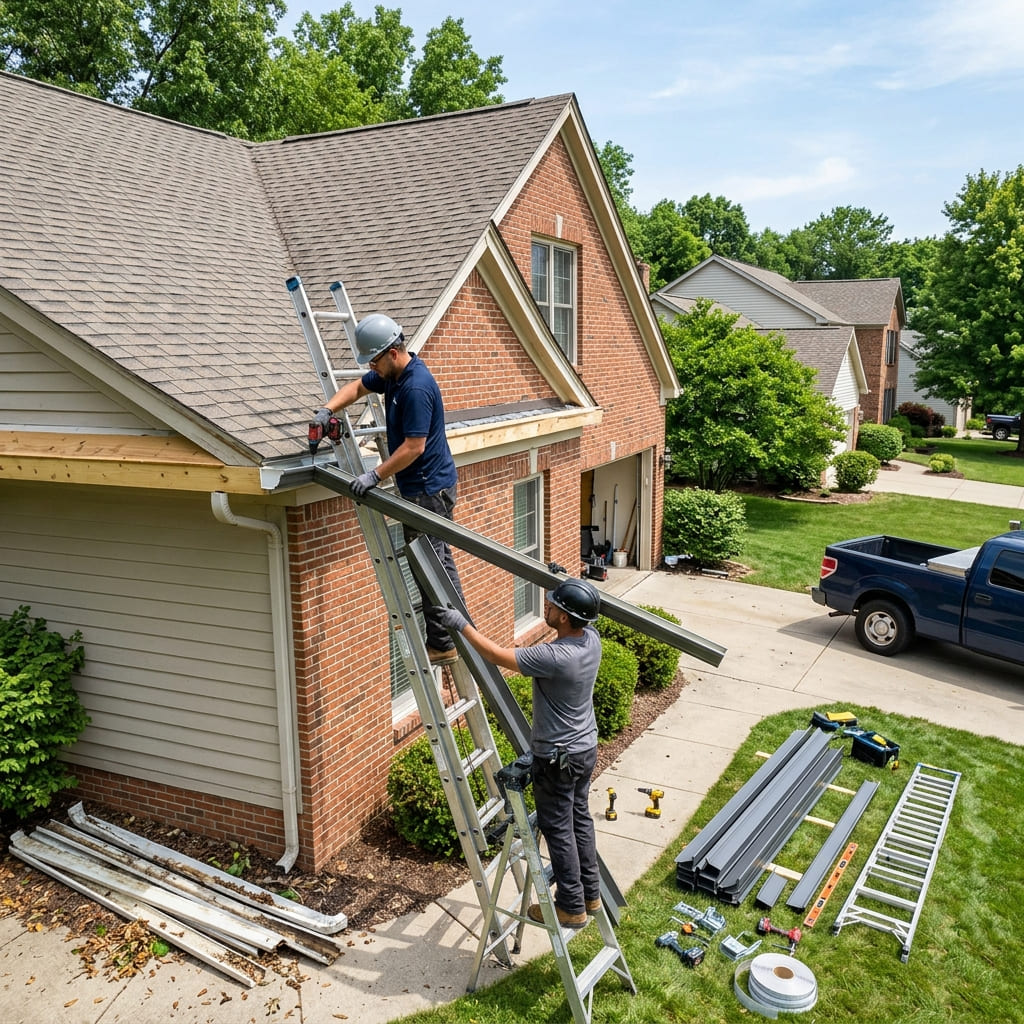
Corten steel gutters install for $20 to $35 per linear foot and last 40 years or more in a dry climate like Boise's. Weathering steel is a low-alloy steel formulated so that its surface rust forms a tight, adherent layer instead of flaking off — that layer then seals the metal beneath it and slows further corrosion.
The result is a gutter that goes from mill-gray to bright orange to a deep rust-brown over the first couple of years, and then stays there. It is a deliberate architectural material, not a failure state, and it has become one of the defining details of contemporary Idaho hillside architecture.
How weathering steel actually works
Weathering steel works through controlled corrosion, which sounds like a contradiction and is not. Ordinary carbon steel rusts into iron oxide that is porous and poorly bonded — it flakes away, exposing fresh metal underneath, and the process repeats until the section is gone.
Corten's alloy content — copper, chromium, nickel, and phosphorus — changes the structure of that oxide layer. Instead of flaking, it forms a dense, tightly adhering film that seals the surface. Corrosion slows dramatically once that patina establishes, and the material reaches a near-stable state.
The critical requirement is wet-dry cycling. The patina forms and stabilizes only if the surface gets to dry out between wettings. In constantly damp conditions, or where water is trapped against the metal, the protective layer never sets up properly and the steel corrodes conventionally.
Why Boise suits Corten
Boise's climate is close to ideal for weathering steel, which is a genuine and unusual advantage rather than a marketing line.
The Treasure Valley gets roughly 11 to 12 inches of precipitation a year, delivered in concentrated events separated by long dry periods, at an elevation with strong sun and low humidity. That is exactly the wet-then-thoroughly-dry cycle Corten needs. The valley is also far from any marine environment — salt air is the main condition that defeats weathering steel, and it is simply not a factor in southwest Idaho.
The one local condition to design around is winter. Ice and meltwater standing in a trough for weeks is the "permanently wet" scenario the material does not like. That is why the interior surface of a Corten gutter is frequently coated or lined, leaving the exterior to weather while the water-contact side is protected. Keeping the run clear so water does not stand matters more here than with any other material. See gutter cleaning.
The staining problem — plan for it
Corten runoff stains, and this is the single most common regret when it is installed without planning. During the first one to three years, water coming off weathering steel carries iron oxide particles that deposit as orange streaking on whatever is below.
- Concrete driveways, walkways, and patios stain readily and permanently.
- Light stone, stucco, and masonry pick up rust streaking below the gutter line.
- Composite and wood decking below a downspout discharge will mark.
- Snow banked against the wall in winter transfers staining outward as it melts.
The mitigations are practical rather than clever. Route downspouts to discharge on gravel, planting beds, or a sacrificial splash area instead of concrete. Keep Corten off elevations directly above light stucco or limestone. And accept some staining at the drip line during the weathering-in period as part of the material's character. See downspouts and drainage.
Where Corten fits in the Treasure Valley
Corten gutters show up on a specific and growing category of Idaho house.
Contemporary foothills builds — the modern-rustic architecture going up along the Eagle foothills benches and Boise's hillside neighborhoods, where board-formed concrete, standing-seam metal roofing, heavy timber, and weathering steel are already part of the material palette. On those houses a Corten gutter is continuous with the design rather than an addition to it.
Agricultural and barn-style construction — shop buildings, barndominiums, and metal-roofed outbuildings on acreage in Kuna, Middleton, and the rural edges of the valley, where the rust palette matches corrugated siding and the material's toughness is genuinely useful.
Accent elevations — Corten on the entry or a single feature elevation with matching dark-bronze aluminum elsewhere. It is the same strategy people use with copper, and it works for the same reason: most of the visual impact for a fraction of the whole-house cost.
Corten compared to the alternatives
| Material | Cost/ft | Life | Appearance over time |
|---|---|---|---|
| Corten steel | $20–$35 | 40+ yrs | Orange, then stable rust-brown |
| Copper | $25–$45 | 60+ yrs | Penny, then brown, eventually green |
| Galvanized steel | $10–$18 | 15–25 yrs | Dull gray, then rust failure |
| Aluminum | $8–$16 | 20–30 yrs | Stable painted finish, no change |
Against copper, Corten costs less and reads as rustic rather than refined. Against ordinary galvanized steel, it costs roughly twice as much and lasts roughly twice as long while looking deliberate instead of neglected. Against aluminum, it is a material choice rather than a performance one — aluminum moves the same water for a third of the price.
Straight answers
Corten steel gutter questions
What is Corten steel?
Corten — properly weathering steel — is a low-alloy steel containing copper, chromium, nickel, and phosphorus. Those alloying elements cause the surface rust to form as a tight, adherent layer rather than the flaky scale that ordinary steel produces. That layer then slows further corrosion instead of accelerating it, which is why weathering steel is left deliberately unpainted.
How much do Corten steel gutters cost?
Corten gutters typically install for $20 to $35 per linear foot, placing them between galvanized steel and copper. On a 180-foot home that is roughly $3,600 to $6,300 for the gutter runs. The premium over ordinary steel reflects material cost and the fact that Corten is usually fabricated rather than mass roll-formed.
Do Corten gutters actually rust through?
Eventually, but far more slowly than ordinary steel. Weathering steel is designed for cyclical wet-and-dry exposure — the patina forms and stabilizes when the surface gets to dry out between wettings. Service life of 40 years or more is realistic in a dry climate like Boise's. The one condition that defeats it is permanently trapped moisture, which is why interior gutter surfaces are often coated or lined.
Will Corten stain my siding, patio, or driveway?
Yes, during the first one to three years while the patina is establishing. Runoff carries iron oxide that leaves orange staining on concrete, light stone, stucco, and decking directly below. It is permanent on porous surfaces. Plan downspout discharge points before installation, and expect visible staining at the drip line during the weathering-in period.
Is Corten a good choice in Boise?
Boise is close to ideal for weathering steel. The patina needs wet-dry cycling to form correctly and stabilize, and it degrades in constantly damp or salt-laden environments. A high-desert valley with roughly 11 to 12 inches of annual precipitation and long dry periods gives Corten exactly the exposure pattern it was designed for.
How long does Corten take to develop its patina?
Corten arrives with a mill finish, begins showing orange within weeks, and reaches its mature deep rust-brown over roughly one to three years depending on exposure. South and west elevations weather faster than shaded north sides, so an installation looks uneven for the first year or two before evening out. Pre-weathered material is available at a premium if the uneven phase is a concern.
Get a Corten steel gutter quote
We will price weathering steel honestly against copper and dark-bronze aluminum, and plan the discharge points so the patina does not end up on your driveway.