
Comparison guide
Aluminum vs Copper Gutters
Three times the price, three times the service life, and a finish that changes for the next 40 years. Here is where copper earns its cost on a Treasure Valley home, and where aluminum simply wins.
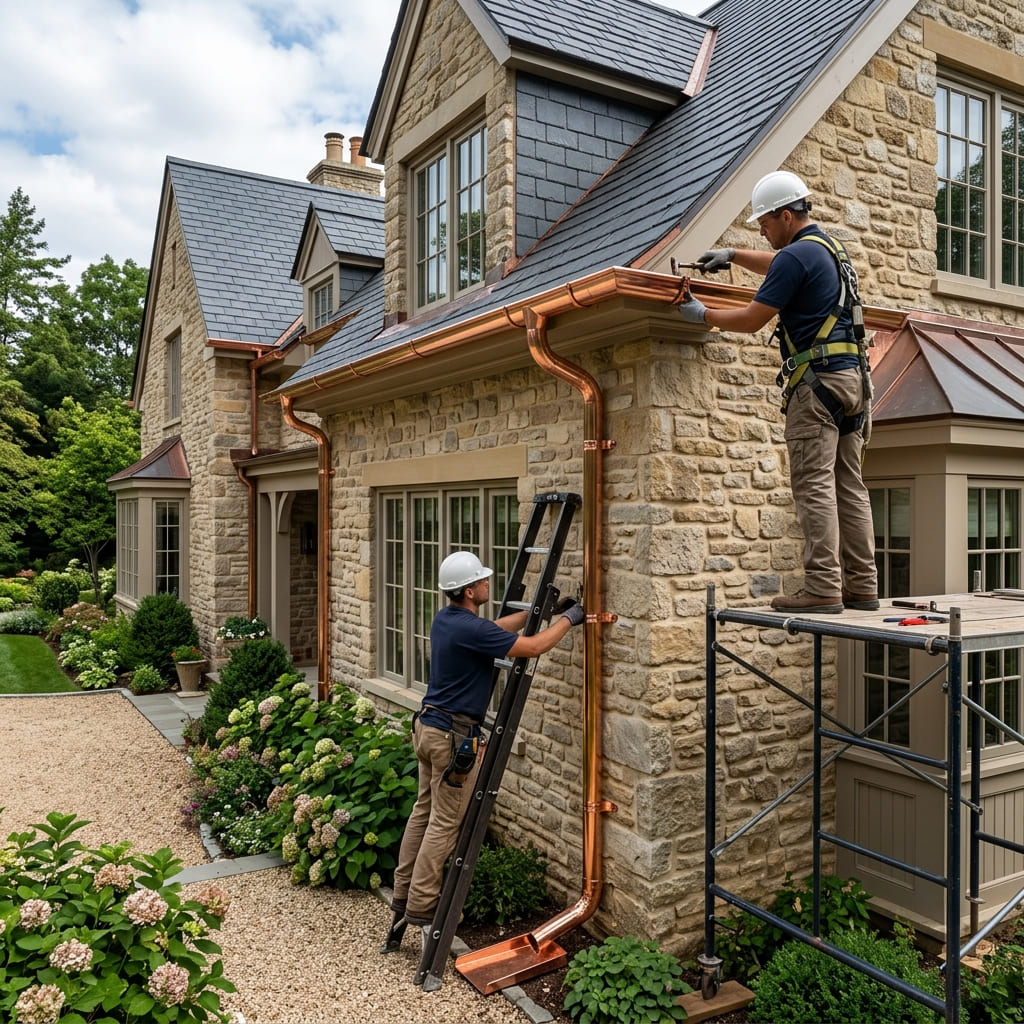
Aluminum gutters cost $8 to $16 per linear foot in Boise and last 20 to 30 years. Copper gutters cost $25 to $45 per foot and last 60 years or more. Per year of service the two materials land closer together than the sticker price suggests — the real difference is how much you pay today, and whether you want a metal that changes color on your house for the rest of your life.
Aluminum is the default across the Treasure Valley for good reasons: it is rustproof, light
enough to hang in long unsupported runs, and available in 25-plus baked-on factory colors.
Copper shows up where architecture asks for it — North End restorations, custom builds in
Eagle, foothills homes with heavy timber and stone. It is a
material choice first and a performance choice second, and any honest comparison should say so.
Aluminum vs copper gutters at a glance
| Aluminum | Copper | |
|---|---|---|
| Installed cost per foot | $8–$16 | $25–$45 |
| Runs on a 180-foot home | $1,440–$2,880 | $4,500–$8,100 |
| Service life | 20–30 years | 60+ years |
| Corner joints | Riveted and sealed with tripolymer | Soldered — a permanent metal bond |
| Finish | 25+ baked-on colors, stays as installed | Bare metal, patinas penny to brown to green |
| Weight | Light — easy long runs, fewer hangers | Heavier — needs copper hangers, closer spacing |
| Dent resistance | Moderate (.032 better than .027) | Good — noticeably stiffer |
| Repairs | Any gutter contractor can patch and reseal | Needs someone who can solder copper |
| Scrap value at end of life | Low | Meaningful — copper is worth recycling |
| Best for | Almost every Treasure Valley home | Architecture where the gutter is visible design |
Cost over time, not cost today
The per-foot gap looks brutal until you divide by service life. Aluminum at $12 per foot over
25 years works out to roughly 48 cents per foot per year. Copper at $35 per foot over 65 years
works out to about 54 cents.
That is close enough that lifetime cost is not really the argument for or against copper — the
argument is that copper asks for all of that money in one year, in a market where the average
complete gutter system runs
$2,705 to $3,660 in aluminum.
Two things do tilt the long-run math toward copper. Soldered corners do not need the resealing that sealed aluminum corners eventually want, and copper carries real scrap value when it finally comes down. Neither changes the fact that you are financing six decades of gutter up front.
How each material behaves in the Treasure Valley
Aluminum
Aluminum does not rust, which is the whole reason it took over. In Boise the practical considerations are gauge and finish. Ask for .032 rather than .027 if ladders will rest on the gutters twice a year for cleaning, because .027 dents into a permanent low spot and low spots hold standing water through a freeze.
On finish, baked-on factory enamel applied to the coil before forming handles Boise UV at 2,700 feet far better than any field-applied paint, and coil manufacturers typically back it with long paint warranties. White, almond, musket brown, and dark bronze are the colors you see most across Meridian and Nampa subdivisions.
Copper
Copper is soft enough to form and stiff enough to resist dents, and its joints are soldered rather than sealed — a metallurgical bond instead of an adhesive one. That is why copper systems outlast the sealant cycle that governs every other material.
The patina timeline in Idaho is slower than most people expect. Bright penny gives way to a dark
chocolate brown within a few years, and the green verdigris stage needs sustained atmospheric
moisture that Boise simply does not have.
If you love the green, understand you may not see it. If you love the brown, the Treasure
Valley climate will hold your house there for a very long time.
Never let copper touch aluminum. Galvanic corrosion means the aluminum sacrifices itself to the copper. That applies to direct contact and to runoff — copper gutter draining onto aluminum flashing, an aluminum downspout, or a metal roof panel will damage it. If both metals appear on one roofline, they need separation and separate drainage.
Where each one fits on Boise-area housing stock
- Post-1990 subdivision homes in Meridian, Star, Kuna, and Middleton — aluminum, without hesitation. Long simple eaves, painted fascia, and a gutter that is meant to disappear.
- North End and East End restorations — copper is often the historically correct answer on Craftsman and Tudor homes, and half-round copper in particular suits the period. See half-round gutters.
- Eagle and foothills custom builds — copper reads as intentional against stone and heavy timber. This is where most Treasure Valley copper actually goes.
- Rentals and flips — aluminum. Copper on a property you will not own in five years is money handed to the next owner, and it is a theft target while it sits there.
- Agricultural-edge homes in Caldwell and rural Canyon County — aluminum, and budget for cleaning. Farm dust does not care what the trough is made of.
- Homes with existing copper flashing or roofing — matching copper avoids the galvanic problem entirely and is the cleanest technical answer.
A middle option most people miss
You do not have to choose one material for the whole house. A common approach on Treasure Valley remodels is aluminum on the back and side elevations, where nobody looks, and copper on the front entry, a portico, or a single feature dormer.
That gets the visual return where it is actually visible for a fraction of a full copper system.
The constraint is the galvanic rule above — the two metals need separate runs and separate
drainage rather than sharing a corner.
If the goal is durability rather than appearance, galvanized or
galvalume steel at $10 to $18 per foot is the more logical step up from aluminum, and
Corten offers a weathered look at $20 to $35.
How to decide
Ask whether the gutter is part of how the house looks. On a home where the gutter is visually
neutral, aluminum is the correct answer and copper is spending for no return.
On a home where the roofline is a designed element — exposed rafter tails, a steep entry gable,
standing seam metal, real stone — copper is doing work that paint cannot.
Then ask how long you are staying. Under ten years, aluminum. Twenty-plus years in a house you have finished renovating, copper starts to make sense on its own terms.
Boise Gutter Service can price both against your measured eave lengths so the decision is made against real numbers for your roofline instead of a per-foot range. Full detail on each material lives on the aluminum gutters and copper gutters pages.
Straight answers
Aluminum vs copper gutter questions
Are copper gutters worth it in Boise?
Copper is worth it when you plan to keep the house and the architecture justifies the look. At $25 to $45 per linear foot against $8 to $16 for aluminum, copper costs roughly three times as much, and it lasts roughly three times as long — 60-plus years versus 20 to 30. The math is close to a wash over a lifetime, so the honest deciding factors are appearance, ownership horizon, and cash flow rather than pure economics.
How much more do copper gutters cost than aluminum?
On a typical 180-foot Boise home, seamless aluminum runs land around $1,440 to $2,880 and copper lands around $4,500 to $8,100 for the same footage, before downspouts. Copper downspouts, soldered corners, and copper hangers push a complete system higher still. For context, the Idaho average for a full aluminum gutter system is $2,705 to $3,660.
Do copper gutters turn green in Idaho?
Eventually, but slowly. Copper moves from bright penny through a dark bronze brown, then toward the green verdigris most people picture. In humid coastal air that can take 10 to 15 years; in Boise’s dry high-desert climate it commonly takes far longer, and many Treasure Valley homes sit in the brown stage for decades. If you want the green, plan on waiting. If you want the brown, Boise is a good place for it.
Can aluminum and copper gutters be mixed on one house?
Physically yes, but they should never touch. Copper in direct contact with aluminum sets up galvanic corrosion, and the aluminum is the one that corrodes. That includes runoff — copper gutter draining onto an aluminum roof, flashing, or downspout will eat it over time. If you are mixing materials on one roofline, they need physical separation and separate drainage paths.
Are copper gutters seamless?
They can be. Copper roll-forms the same way aluminum does, so continuous runs are possible. The difference is at the corners and outlets: quality copper work is soldered rather than sealed with tripolymer, which is why it outlives the sealant-dependent joints on every other material. Soldering copper is a real skill, and it is the main reason copper labor costs more per foot.
Which material is better for a Boise foothills home?
It depends on what the roof does in winter. Copper is stiffer than aluminum and shrugs off ladder traffic, but neither material likes a sheet of snow releasing off a metal roof — that is a case for steel or for snow retention on the roof itself. For fire-conscious foothills properties, both aluminum and copper are non-combustible, which already puts them ahead of vinyl. See aluminum vs steel.
Get a gutter material quote in Boise
Tell us what your roofline looks like and get written pricing for aluminum, steel, and copper — no charge and no obligation.