
Gutter profiles
K-Style Gutters
The ogee profile on roughly nine out of ten Idaho homes — more capacity per inch of width than any round gutter, and it mounts flush to fascia without brackets.
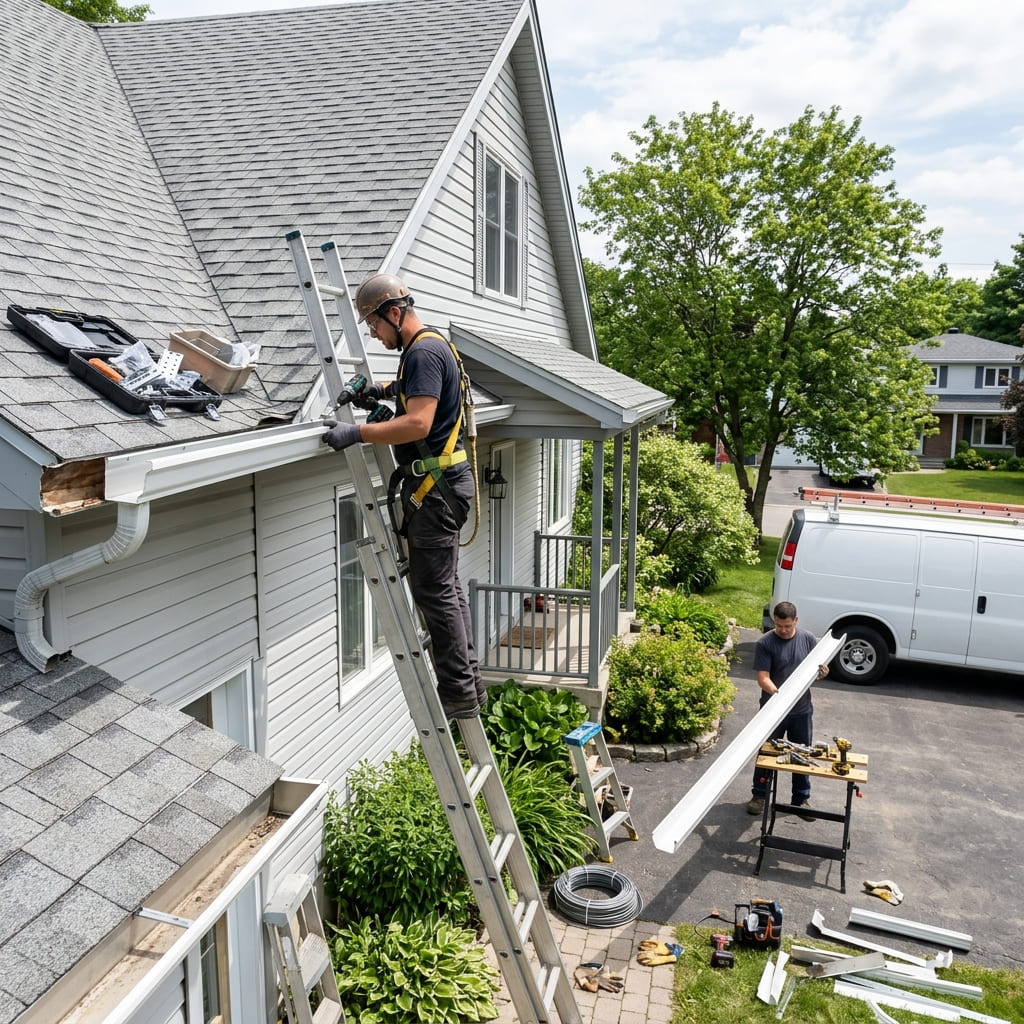
K-style gutters install for $8 to $16 per linear foot in seamless aluminum and appear on roughly nine out of ten homes across the Treasure Valley. The profile has a flat back that mounts directly to fascia, a flat bottom, and a curved decorative front face that reads like crown molding from the ground.
The name is an accident of history — "K" was simply the letter assigned to the profile in an old sheet-metal catalog. It describes nothing about the shape. What matters is what the shape does: it holds more water than a round gutter of the same visible width, and it hangs without exterior brackets.
Why K-style became the standard
K-style became the residential standard for three practical reasons, all of which still apply on a Boise house today.
First, capacity per inch of width. The flat bottom and near-vertical sides produce a roughly rectangular cross-section. A half-round of the same nominal width is a semicircle, which encloses considerably less area. On a house where the eave line has limited visual room, K-style moves more water for the same apparent size.
Second, it mounts flush. The flat back sits directly against the fascia board and takes hidden hangers screwed into rafter tails. Half-round requires exterior brackets, which are visible and add cost.
Third, it looks intentional. The curved front face mimics crown molding, so on most 20th and 21st century American architecture a K-style gutter reads as a trim detail rather than as plumbing bolted to the roofline.
K-style sizes and capacity
K-style gutters come in two residential sizes, and choosing correctly is more consequential in Boise than in a gentler climate — an undersized run overflows in a July thunderstorm and holds ice in January.
| Size | Paired downspout | Relative capacity | Use when |
|---|---|---|---|
| 5-inch | 2x3 | Baseline | Single-story, moderate pitch, runs under 40 ft |
| 6-inch | 3x4 | ~40% more | Steep roofs, long runs, valleys, metal roofing, heavy tree cover |
The downspout pairing matters as much as the trough size. A 6-inch gutter feeding a 2x3 downspout just relocates the bottleneck — the trough fills faster than the outlet can drain it. Upsizing both together is what actually adds capacity. See downspouts and drainage.
K-style materials
K-style is formed in every common gutter material, which is another reason it dominates — the profile is not a constraint on material choice.
- Aluminum ($8–$16/ft) — the default. Formed seamlessly on site in .027 or .032 gauge, available in 25-plus baked-on colors.
- Galvanized or galvalume steel ($10–$18/ft) — stiffer and more impact resistant, for metal roofs and properties with falling limbs.
- Copper ($25–$45/ft) — soldered joints and a 60-plus year life, on architecture that supports the look.
- Corten weathering steel ($20–$35/ft) — the rust-patina profile on contemporary foothills builds.
K-style's one real weakness
K-style has interior corners, and debris packs into them. Where the flat bottom meets the sides, there is a ninety-degree angle that leaf matter, shingle grit, and pine needles settle into and stay in. Water flows over the top of that accumulation rather than moving it along.
In the Treasure Valley that matters most under mature canopy — the North End, East End, the Boise River corridor through Garden City, and foothills properties with conifers. A half-round gutter has no corners, so debris tends to migrate toward the outlet with the water instead of settling.
There are two practical responses. Keep K-style and add micro-mesh guards, which prevents the material reaching the trough in the first place. Or clean twice a year by hand rather than by blower, since a blower will not lift compacted material out of a corner. See gutter cleaning.
K-style vs half-round at a glance
| K-style | Half-round | |
|---|---|---|
| Capacity at same width | Higher | Lower |
| Debris shedding | Corners trap material | Smooth curve moves material along |
| Mounting | Flush to fascia, hidden hangers | Exterior brackets |
| Cost, aluminum | $8–$16 per foot | $12–$20 per foot |
| Best suited to | Most 20th and 21st century homes | Historic, Craftsman, and high-end architecture |
For the large majority of Boise homes, K-style is the correct choice and half-round is an architectural preference. The exception is a house under heavy conifer cover where debris is the dominant problem — there, half-round's shedding behavior earns its price difference.
Straight answers
K-style gutter questions
What is a K-style gutter?
A K-style gutter is the profile with a flat back, a flat bottom, and a decorative curved front face that resembles crown molding. The "K" is simply its designation in an old sheet-metal profile catalog — it does not describe the shape. It is the most common residential gutter profile in the United States and on roughly nine out of ten homes in the Treasure Valley.
How much do K-style gutters cost?
K-style pricing depends on material and size. Seamless aluminum runs $8 to $16 per linear foot installed, galvanized steel $10 to $18, and copper $25 to $45. Six-inch K-style adds roughly $2 to $4 per foot over 5-inch. Those numbers put a typical Boise home at $2,705 to $3,660 for a full system — see the installation cost guide.
Does K-style hold more water than half-round?
Yes — meaningfully more, at the same nominal width. A K-style gutter has a flat bottom and near-vertical sides, so its cross-section is close to rectangular. A half-round of the same width is a semicircle, which encloses substantially less area. That is why K-style became the residential standard: more capacity per inch of visible width, and it mounts flush to the fascia without brackets.
Should I get 5-inch or 6-inch K-style?
Five-inch handles most single-story homes with moderate roof pitch. Choose 6-inch for roof pitches above 6:12, unbroken runs longer than about 40 feet, valleys that feed two roof planes into one gutter section, and metal roofs where snow releases all at once. Six-inch carries roughly 40% more water and pairs with 3x4 downspouts instead of 2x3.
Do K-style gutters clog more than half-round?
Somewhat, yes. K-style has interior corners where the bottom meets the sides, and debris packs into those corners and stays there. A half-round has no corners — the curve encourages material to move toward the outlet with the water. Under mature cottonwood or pine, that difference is noticeable. It is the main functional argument for half-round, and one reason micro-mesh guards pair well with K-style.
Can K-style gutters be seamless?
Yes, and nearly all modern K-style is. The profile is formed from flat coil on a roll former at your house and cut to your exact eave length, so joints exist only at corners, end caps, and outlets. Sectional K-style in 10-foot lengths is still sold for DIY use, but it introduces a joint every 10 feet — each one a future leak under Boise freeze-thaw cycling. See seamless gutters.
Get a K-style gutter quote
Five-inch or six-inch, aluminum through copper — measured, formed on site, and quoted in writing before anything is ordered.